
How easy is it to pass Cyber Essentials Plus Certification first time?
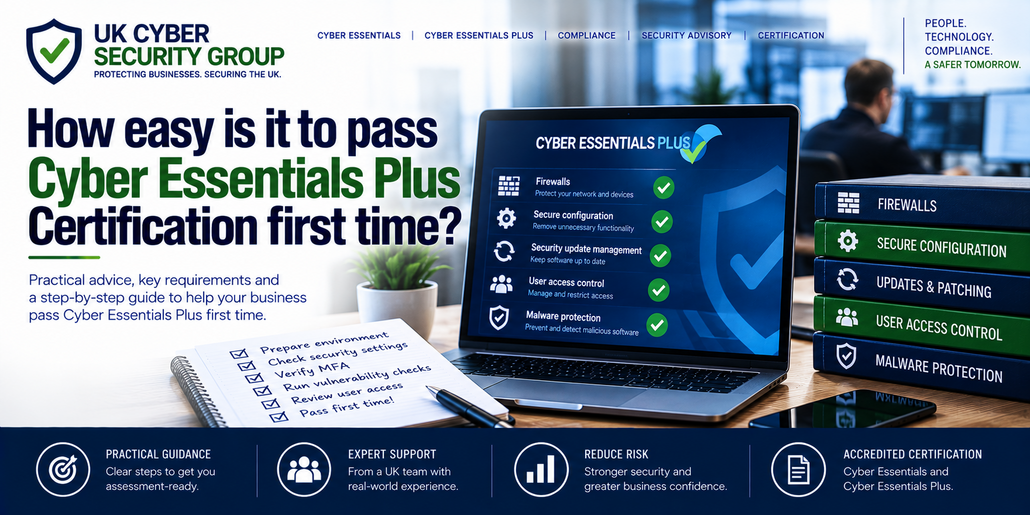
How easy is it to pass Cyber Essentials Plus Certification first time?
Passing Cyber Essentials Plus certification first time is achievable for a well-managed organisation, but it should not be treated as an automatic step after completing Cyber Essentials.
Cyber Essentials Plus uses the same five technical controls as Cyber Essentials, but an independent assessor tests your IT environment to confirm that those controls actually work. That makes the Plus assessment much harder to pass through paperwork alone.
For an organisation that manages devices centrally, keeps software supported, applies security fixes promptly, enforces multi-factor authentication, controls administrator privileges and maintains reliable malware protection, the assessment can be relatively straightforward.
For a business with unmanaged laptops, inconsistent security settings, forgotten cloud accounts, unsupported applications or poor security update management, Cyber Essentials Plus can expose weaknesses quickly.
The National Cyber Security Centre currently lists Cyber Essentials Requirements for IT Infrastructure v3.3 as the requirements in force from 27 April 2026. The current published Cyber Essentials Plus Test Specification remains v3.2.
The key to making Cyber Essentials Plus easy is therefore preparation. You want the assessment to confirm an existing security baseline rather than discover what your organisation needs to fix.
UK Cyber Security Group Ltd provides Cyber Essentials and Cyber Essentials Plus certification services and is a registered Cyber Essentials Certification Body. It also provides supported certification routes for organisations that need additional guidance through the process.
Cyber Essentials Plus is harder than Cyber Essentials for a good reason
Cyber Essentials starts with a verified self-assessment.
Your organisation answers questions about the way it manages the five Cyber Essentials technical controls. An authorised assessor reviews those answers before certification.
Cyber Essentials Plus takes that same baseline and independently tests it.
IASME confirms that Cyber Essentials and Cyber Essentials Plus assess the same five controls. Plus provides a higher level of assurance because a third party checks whether the controls have been implemented correctly.
That means Plus is not necessarily more complicated in terms of what security you need.
It is more demanding in terms of proving that your security works.
Your answers need to match reality.
If you claim that multi-factor authentication protects a cloud service, the assessor can test it.
If you state that software remains supported and receives appropriate security fixes, vulnerability scans can verify that.
If you state that ordinary users do not have administrative privileges, the assessor can test account separation.
This independent verification explains why businesses should prepare properly before booking the technical assessment.
So, how easy is Cyber Essentials Plus?
There is no official published first-attempt pass percentage that allows a reliable statement such as “most organisations pass first time”.
Government statistics show how many certificates organisations achieve, but they do not currently publish a national first-attempt Cyber Essentials Plus success rate.
The latest government figures show that 61,430 Cyber Essentials certificates were awarded in the twelve months from July 2025 to June 2026. Of those, 46,245 were Cyber Essentials and 15,185 were Cyber Essentials Plus.
That level of adoption demonstrates that Plus is achievable across a large number of organisations.
Difficulty depends heavily on the condition of your IT environment.
A company that already follows good cyber hygiene may need only minor preparation.
Another business may discover that years of inconsistent IT management have created unsupported applications, unnecessary administrator accounts and devices missing important fixes.
The certificate is the same.
The amount of work required to reach it can be very different.
What are the key requirements for achieving Cyber Essentials certification?
Cyber Essentials focuses on five technical controls:
- Firewalls
- Secure configuration
- Security update management
- User access control
- Malware protection
These controls create the security foundation for Cyber Essentials Plus.
Firewalls help protect systems from unnecessary connections.
Secure configuration removes insecure defaults and unnecessary functionality.
Security update management addresses known vulnerabilities.
User access control restricts access according to genuine business requirements.
Malware protection helps prevent malicious software from compromising devices.
The controls sound simple, but successful implementation needs consistency.
One well-managed laptop does not compensate for another laptop that has not received important security fixes.
One administrator protected by MFA does not solve the problem if another privileged account can access cloud services without it.
Plus checks whether the baseline exists across the environment rather than only in policy documents.
Scope can make the assessment easier or harder
One of the biggest factors affecting Cyber Essentials Plus is scope.
The Plus assessment scope needs to match the associated Cyber Essentials assessment.
The assessor must agree the boundary before testing begins and verify the scope as part of the assessment.
Before booking Plus, make sure you know what sits inside that boundary.
Consider:
- Employee laptops
- Desktop computers
- Servers
- Mobile devices where relevant
- Public internet connections
- Cloud services
- Internet-facing systems
- Infrastructure hosted with cloud providers
- Administrator accounts
- Remote employees
The more accurate your asset information is, the easier the audit becomes.
Poor scope records create uncertainty.
You do not want to discover during the assessment that an important group of devices was missing from your inventory.
Partial scope needs genuine separation
Some organisations certify only part of their environment.
Where the Cyber Essentials scope does not cover the whole organisation, the assessor needs to verify appropriate segregation.
Simply writing that another network sits outside scope does not necessarily prove meaningful separation.
If systems freely communicate across the claimed boundary, the assessor may need further evidence.
Discuss complicated scoping arrangements with your Certification Body before assessment day.
Simple scope normally means simpler testing.
Representative sampling should not worry a well-managed business
Cyber Essentials Plus does not necessarily involve testing every employee device.
IASME states that assessors test a random representative sample, commonly around 10 per cent, and then decide whether further testing is necessary. The audit also covers all internet gateways and all servers with services accessible to unauthenticated internet users.
Sampling should not be viewed as an opportunity to prepare only a few machines.
You normally do not control which devices become part of the sample.
A better strategy is to manage every device to the same baseline.
Central management helps considerably.
If every Windows laptop receives the same security policies, update settings, endpoint protection and user privilege controls, the random selection becomes far less important.
The assessor should see roughly the same security position whichever appropriate device enters the sample.
Security update management can make or break the assessment
One of the most important areas to check before Plus is security update management.
The Cyber Essentials Plus technical assessment includes authenticated vulnerability checks against sampled systems.
The purpose is to identify important vulnerabilities that should already have received vendor fixes.
Do not limit your review to operating system updates.
Applications matter too.
Browsers matter.
Office software matters.
Server applications matter.
Remote access software matters.
Third-party applications can contain vulnerabilities just as easily as the operating system.
Before assessment, ask:
Are all operating systems supported?
Are all relevant applications supported?
Have important security fixes been applied?
Are remote devices receiving them?
Are any machines regularly offline?
Have any updates failed?
Are users able to delay updates indefinitely?
Does central management show devices that have stopped reporting?
These checks often uncover issues before they become formal audit failures.
The 2026 update makes whole-environment compliance even more important
IASME introduced an important Cyber Essentials Plus change in April 2026.
IASME said audits had identified cases where organisations corrected update problems only on machines included in the original assessment sample.
The updated process addresses this behaviour.
When an organisation fails the initial update-management sample and then carries out remediation, the assessor now checks the original systems and a new random sample during the retest.
A second failure results in revocation of the associated verified self-assessment certificate.
This makes the intended standard very clear.
Do not prepare the sample.
Prepare the organisation.
If one device fails because management did not apply a required security fix, investigate whether the same weakness affects other systems.
Fix the cause rather than the individual machine.
Unsupported software should be removed from the problem before Plus
Unsupported software creates another major risk to certification.
IASME states that an organisation cannot achieve Cyber Essentials if unsupported software remains within scope.
Check this before submitting the verified self-assessment.
Create an accurate inventory covering operating systems and important applications.
Review vendor support dates.
Remove software that employees no longer need.
Upgrade systems where appropriate.
If a business-critical application depends on an old platform, discuss the issue before the assessment rather than discovering it through testing.
A computer can function perfectly from an employee’s point of view while still failing the security requirement because its software no longer receives vendor security support.
Internet-facing systems receive direct attention
Cyber Essentials Plus includes external vulnerability assessment.
The assessor reviews the organisation’s public IP addresses and internet-accessible services to determine whether common weaknesses could allow an attacker to compromise systems.
This means forgotten internet-facing equipment can create problems.
Review:
- Public IP addresses
- Firewall rules
- Remote access services
- Internet-facing servers
- Cloud-hosted infrastructure
- Router management
- Old systems
- Test environments
- Unnecessary open services
Ask whether every externally accessible service still has a legitimate business purpose.
Remove unnecessary exposure.
Make sure systems receive appropriate security fixes.
A forgotten service can undermine otherwise strong internal security.
Malware protection needs to work, not merely exist
Many organisations use established endpoint protection platforms and assume this part of Plus will automatically pass.
That is not always enough.
The assessor needs evidence that malware protection works on the sampled systems.
Depending on your configuration, testing can include checking whether anti-malware software runs correctly and observing what happens when safe test files arrive through email or web browsing.
Review your endpoint security management console before the audit.
Look for:
- Devices that have stopped checking in
- Disabled protection
- Outdated components
- Unexpected exclusions
- Incorrect policies
- New devices without security controls
Investigate unusual entries.
Do not simply rely on the presence of an endpoint security icon.
The management platform should show that protection operates consistently across the relevant environment.
MFA often decides whether cloud services pass
Modern businesses rely heavily on cloud platforms.
Microsoft 365, Google Workspace, CRM systems, financial platforms and many other services may fall within the assessment scope.
The current Plus technical specification includes MFA testing for cloud services used within scope, including user and administrator access.
IASME explains that cloud services need checks for a normal user and an administrator account.
The important distinction is between MFA registration and MFA enforcement.
A user may have an authentication application registered but still access a service without an MFA challenge because of an exclusion, policy gap or trusted session.
Test the real behaviour.
Use a clean browser session.
Use private browsing.
Check the service from an appropriate untrusted context.
Confirm that the authentication process requests the additional factor.
Test administrators separately.
One forgotten privileged account can create unnecessary difficulty.
Administrator rights deserve a full review
Cyber Essentials wants organisations to restrict administrative privileges.
Employees should not normally conduct routine work using privileged accounts when they do not need those rights.
Cyber Essentials Plus tests this through account separation.
The assessor may ask a standard user on a sampled device to perform an administrative action.
The expected result is that the system requires appropriate administrator credentials rather than allowing the normal account to continue with existing privileges.
Before assessment, review:
- Local administrator groups
- Cloud administrator roles
- Old IT supplier accounts
- Contractor access
- Temporary privileged accounts
- Former employee accounts
- Privileges granted during old projects
Remove access that nobody needs.
This exercise improves security as well as certification readiness.
How can I prepare my small business for Cyber Essentials assessment?
Small businesses can often prepare for Cyber Essentials Plus more easily than larger organisations because they have fewer systems to manage.
However, fewer employees do not automatically mean a simple IT environment.
A ten-person company might still use laptops, smartphones, Microsoft 365, cloud accounting, CRM software, online backups, external IT support and multiple SaaS platforms.
Preparation should start with an inventory.
Know what you have.
Then review the current Cyber Essentials questions and technical requirements.
The NCSC provides the current requirements and free resources, while IASME allows organisations to preview the Danzell question set used for assessments from 27 April 2026.
Next, carry out a technical readiness review before Plus.
Check support status.
Check updates.
Check administrator rights.
Check MFA.
Check malware protection.
Check internet exposure.
Resolve problems before the assessor starts testing.
Use the current Danzell questions
Cyber Essentials changes over time.
Organisations preparing now should use the current material.
IASME’s current questionnaire schedule states that the Danzell question set applies from 27 April 2026.
Do not use an old question booklet saved from a previous certification year.
Security requirements evolve.
Cloud services evolve.
Vendor support changes.
The best preparation always starts with the current NCSC and IASME documentation.
What software solutions support compliance with Cyber Essentials standards?
No product provides automatic Cyber Essentials compliance.
Software can make the controls much easier to manage, but configuration and ongoing operation remain important.
Useful technology can include:
- Endpoint protection
- Endpoint management
- Vulnerability management
- Asset discovery
- Patch management
- Identity management
- Multi-factor authentication
- Mobile device management
- Firewall management
- Security monitoring
Microsoft environments may use services such as Intune for device management and Entra for identity and access controls.
Endpoint security platforms such as Microsoft Defender, SentinelOne and comparable products can support malware protection.
Vulnerability tools can identify missing fixes before the formal assessment.
Asset tools can highlight forgotten systems.
The assessor does not award Plus because an organisation owns particular software.
The assessor looks at whether the required controls operate effectively.
Remote workers can still affect the result
Remote working can create inconsistency.
A laptop used permanently from home may miss updates or stop checking into management services.
Another device may not receive the same policy as equipment inside the office.
Before Plus, review remote equipment separately.
Check when each device last reported.
Confirm endpoint protection status.
Review outstanding updates.
Make sure supported software remains in use.
Verify user privilege settings.
Confirm cloud authentication works correctly.
Remote employees should operate within the same security baseline as office-based staff.
Do not forget mobile equipment
Phones and tablets can access cloud services and company information.
Review the current Cyber Essentials requirements to determine how your mobile environment fits within scope.
Remove access from obsolete equipment.
Check operating system support.
Review company-managed devices.
Consider personal equipment where it accesses business services.
Mobile devices often become overlooked because organisations concentrate heavily on Windows endpoints.
Good scope management prevents that mistake.
The three-month Plus window matters
IASME states that organisations can complete Cyber Essentials Plus within three months of the associated Cyber Essentials certification.
If the verified self-assessment was achieved less than three months earlier, the organisation does not need to complete the self-assessment questions again for the Plus process.
Use that window efficiently.
Do not achieve Cyber Essentials and then delay the technical preparation.
The environment can change quickly.
New employees join.
New laptops arrive.
Applications change.
Accounts get created.
Completing Plus relatively soon after the verified assessment reduces the chance that the environment drifts away from the answers you originally submitted.
Run your own test before the formal test
One of the best ways to make Cyber Essentials Plus easier is to conduct a readiness assessment.
Think like the assessor.
Review public exposure.
Check a representative selection of user devices.
Run appropriate vulnerability checks.
Review supported software.
Test MFA.
Check malware protection.
Try an administrative action from a normal user account.
Compare the asset inventory with what management platforms report.
Look for inconsistencies.
The goal is not to create another certification.
The goal is to identify surprises before the official assessor does.
Cyber Essentials Plus needs a stronger pass position
The technical audit should verify that all required control areas operate correctly.
A business should not approach Plus assuming that passing most checks will be sufficient.
The current test specification sets pass and fail criteria for the technical assessment and requires the controls to meet the required standard.
This makes preparation different from an informal security health check.
The assessor has a defined specification.
If a required control fails, remediation may become necessary before certification can proceed.
The safest approach is therefore to enter the assessment expecting every sampled system to meet the requirement.
Cyber risk explains why the assessment is demanding
Cyber Essentials Plus is not designed to create unnecessary difficulty.
The controls address genuine risks.
The UK Government’s Cyber Security Breaches Survey 2025/2026 found that 43 per cent of UK businesses identified a cyber security breach or attack during the previous twelve months.
That represents approximately 612,000 businesses.
Among small businesses, 46 per cent identified a breach or attack.
The figure increased to 65 per cent for medium businesses and 69 per cent for large businesses.
Phishing remained the most commonly identified attack, affecting 38 per cent of businesses.
Cyber Essentials concentrates on practical controls that reduce exposure to many common attacks.
Plus then verifies that businesses have actually implemented them.
Cyber Essentials Plus adoption continues to rise
The latest government management information shows 61,430 Cyber Essentials certificates awarded during the twelve months ending June 2026.
Cyber Essentials Plus accounted for 15,185 of those certificates.
Government information also states that organisations with Cyber Essentials are 92 per cent less likely to make a cyber insurance claim. This figure relates specifically to insurance claims and should not be interpreted as meaning certification eliminates 92 per cent of cyber attacks.
These figures show that the scheme has become an established part of UK cyber resilience.
Cyber Essentials Plus remains achievable while providing more assurance than the verified self-assessment alone.
Can I renew my Cyber Essentials certification through an online service?
Yes.
Cyber Essentials uses an online assessment process, and organisations can complete their verified self-assessment through an authorised Certification Body.
Certificates remain valid for twelve months.
Renewal should involve reviewing the environment rather than simply copying the previous answers.
Consider what has changed.
Have you added new cloud services?
Have employees changed?
Have administrator accounts changed?
Have you replaced laptops?
Has your office network changed?
Are operating systems still supported?
Do new applications fall within scope?
Keeping the environment managed throughout the year makes renewal considerably easier.
Which companies provide Cyber Essentials certification services in the UK?
Cyber Essentials certification comes through Certification Bodies licensed within the official Cyber Essentials scheme.
IASME is the NCSC’s official Cyber Essentials Delivery Partner and works with a network of more than 350 Certification Bodies across the UK and Crown Dependencies.
UK Cyber Security Group Ltd is a registered Cyber Essentials Certification Body and provides Cyber Essentials certification alongside Cyber Essentials Plus services.
When looking for Plus certification, speak directly with a Certification Body because the technical assessment needs appropriate planning around your network, systems and scope.
An experienced provider can also help identify obvious readiness issues before the technical audit begins.
Which UK-based firms offer Cyber Essentials consultancy services?
UK businesses can obtain Cyber Essentials guidance from security consultancies, managed service providers, NCSC assured Cyber Advisors and Certification Bodies.
The most useful assistance usually focuses on practical implementation.
Look for support with:
- Scope
- Asset records
- Supported software
- Security updates
- Firewalls
- Secure configuration
- Administrator rights
- MFA
- Malware protection
- Cloud services
- Plus readiness
The NCSC Cyber Advisor scheme also provides independently assured support aimed particularly at small and medium organisations. NCSC states that Cyber Advisor providers need appropriate competence around the Cyber Essentials technical controls and practical support.
UK Cyber Security Group offers certification alongside supported assessment options, giving businesses a route to additional help where they do not have sufficient internal information security knowledge.
What makes Cyber Essentials Plus feel difficult?
Cyber Essentials Plus tends to feel difficult when IT management lacks consistency.
Problems often come from ordinary operational weaknesses rather than advanced cyber security issues.
Examples include:
- Forgotten laptops
- Old applications
- Missing updates
- Local administrator accounts
- MFA exclusions
- Old cloud users
- Endpoint agents that stopped reporting
- Unnecessary internet-facing services
- Poor asset records
- Unsupported software
- Remote systems outside normal management
None of these issues require an attacker with advanced capabilities.
They simply show gaps in basic cyber hygiene.
Organisations that maintain those basics throughout the year usually find Plus considerably easier.
What makes it easier?
Standardisation makes a major difference.
Use consistent endpoint management.
Keep software inventories current.
Use common device configurations where possible.
Manage updates centrally.
Apply MFA consistently.
Separate administrator accounts from ordinary user activity.
Review access regularly.
Maintain endpoint protection.
Remove old systems.
Keep scope records current.
When controls operate consistently, the assessment becomes verification rather than discovery.
A practical readiness check before you book Plus
Before committing to the audit, work through the following questions:
- Is the Cyber Essentials self-assessment accurate?
- Is the certification less than three months old when Plus takes place?
- Does the Plus scope match the Cyber Essentials scope?
- Is any excluded area properly segregated?
- Do we have an accurate device inventory?
- Do we understand every cloud service within scope?
- Is all software supported?
- Have required security fixes been applied throughout the environment?
- Have we reviewed public IP addresses?
- Have we removed unnecessary internet-facing services?
- Does malware protection operate across all relevant systems?
- Are endpoint security platforms reporting normally?
- Does MFA work for users and administrators?
- Have we tested MFA from a clean session?
- Have we removed unnecessary administrator privileges?
- Can normal users perform administrative tasks without separate credentials?
- Are remote devices managed properly?
- Have we reviewed mobile equipment?
- Can we provide the representative devices required for testing?
- Have we performed our own readiness checks?
If you can confidently answer yes to these points, Cyber Essentials Plus should feel much more manageable.
Do not wait for assessment day to discover the environment
Preparation should happen before the assessor connects.
Have the correct technical staff available.
Make sure relevant users can support the testing.
Know where the sample devices are.
Have your public IP information ready.
Know which cloud services are used.
Make sure management platforms are accessible.
Check that devices are switched on and available.
Assessment day should not become an IT discovery exercise.
Good organisation reduces unnecessary delays and makes the assessor’s work easier.
A first-time pass is realistic for a prepared organisation
Cyber Essentials Plus is not designed to be impossible.
More than 15,000 Plus certificates were awarded during the latest reported twelve-month period.
However, the technical assessment has real value precisely because businesses cannot pass simply by writing reassuring answers on a questionnaire.
The assessor tests the controls.
For an organisation with good IT management, that should not be frightening.
If you already know your assets, keep software supported, manage updates consistently, enforce MFA, control administrator privileges and maintain endpoint protection, much of the work is already done.
The preparation then becomes a process of checking scope, validating the environment and resolving smaller gaps.
For organisations with weaker IT management, Plus can require more work.
That work is still valuable because the audit preparation exposes weaknesses that attackers could otherwise exploit.
Make Cyber Essentials Plus part of normal IT management
The easiest organisation to certify is one that does not dramatically change its security practices for the assessment.
Security updates should happen because the business needs secure systems.
MFA should remain enforced because account compromise creates risk.
Administrator access should stay limited because privileged accounts are powerful.
Malware protection should remain active because malicious software is a constant threat.
Unsupported systems should leave the environment because vendors no longer provide appropriate security fixes.
Cyber Essentials Plus then becomes independent confirmation of controls the business already operates.
That is the position to aim for.
Is Cyber Essentials Plus easy?
For a well-prepared organisation, Cyber Essentials Plus can be straightforward.
For an organisation with poorly managed IT, it can be challenging.
The difference rarely comes down to company headcount alone.
It comes down to control.
Do you know what equipment you have?
Do you know which software runs on it?
Do you know whether that software remains supported?
Can you apply important security fixes reliably?
Can ordinary users administer their devices?
Does MFA really protect cloud access?
Can you see whether endpoint protection operates correctly?
Do you know what the internet exposes?
If you can answer those questions confidently, the technical audit becomes far less daunting.
UK Cyber Security Group provides Cyber Essentials and Cyber Essentials Plus certification services for businesses that want to demonstrate that these core cyber security controls work effectively.
The best route to passing first time is not finding a shortcut.
It is removing surprises.
Know the scope, manage every device consistently, use the current requirements, perform readiness checks before the audit and correct weaknesses across the whole environment rather than only on the systems selected for testing.
When those foundations are in place, Cyber Essentials Plus becomes what it is intended to be: independent confirmation that your organisation has implemented the Cyber Essentials controls effectively.
UK Cyber Security Group Ltd is here to help
Please check out our Free Cyber Insurance
Other blog posts, Your ISO 27001 Questions Answered, Get ISO 27001 Certified ,
If you would like to know more, do get in touch as we are happy to answer any questions. Looking to improve your cybersecurity but not sure where to start? Begin by getting certified in Cyber Essentials, the UK government’s scheme that covers all the technical controls that will provide the protection that you need to help guard against criminal attacks. Or just get in touch by clicking contact us


