
How long does the Cyber Essentials Plus audit take?
How long does the Cyber Essentials Plus audit take?
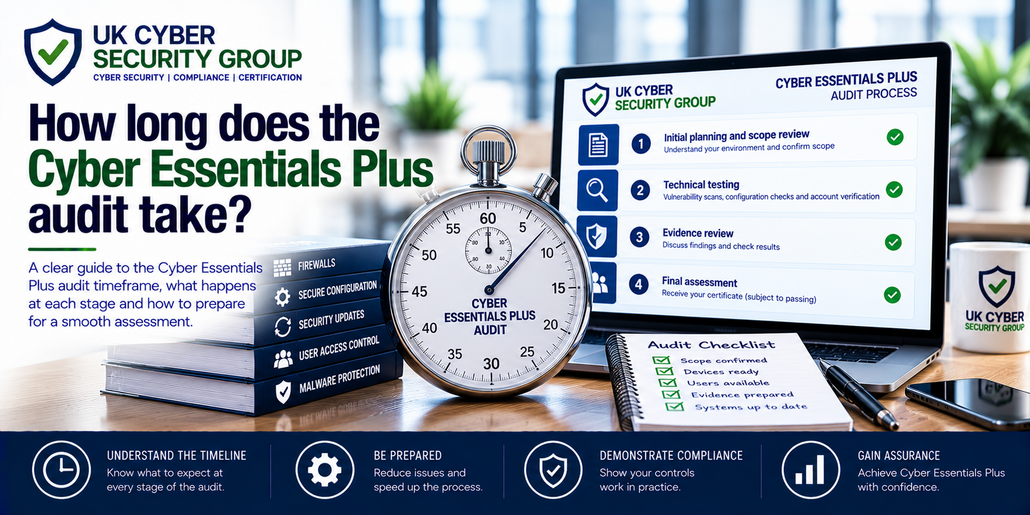
The Cyber Essentials Plus audit typically takes around one working day for a straightforward small business, although larger organisations and more complex IT environments may require several days of technical assessment.
The full certification journey can take longer because businesses need to complete Cyber Essentials first, prepare their systems, arrange the technical audit and resolve any security weaknesses identified during testing.
For a small organisation with a well-managed IT environment, the practical assessment may take only a few hours.
For a business operating several offices, numerous cloud services, different operating systems and complicated network infrastructure, the assessor may need considerably more time.
The important point is that Cyber Essentials Plus does not have one fixed audit duration that applies to every organisation.
The assessment follows a defined technical testing process, but the amount of work depends on the environment and the number of systems requiring examination.
The National Cyber Security Centre currently lists Cyber Essentials Requirements for IT Infrastructure v3.3 as the requirements in force from 27 April 2026.
The current published Cyber Essentials Plus Test Specification remains version 3.2.
Cyber Essentials Plus uses the same five technical controls as standard Cyber Essentials, but adds independent verification to confirm that the organisation has implemented those controls correctly.
UK Cyber Security Group Ltd provides Cyber Essentials and Cyber Essentials Plus certification services to UK businesses, including organisations seeking independent technical assurance for customer contracts, supply-chain requirements and public-sector procurement.
Understanding the assessment process before booking can help businesses reduce unnecessary delays and achieve certification more efficiently.
How long does the actual Cyber Essentials Plus audit take?
For many small and medium-sized organisations, the hands-on technical audit can take approximately one working day.
Published guidance from UK Cyber Essentials Plus providers commonly describes assessments taking between one and three working days, depending on the organisation’s complexity.
These figures are practical industry estimates rather than guaranteed official scheme timescales.
A smaller company using centrally managed laptops, Microsoft 365 and a straightforward office network may need less assessor time.
A larger organisation with multiple locations, different operating systems, cloud infrastructure and numerous internet-facing services may require a longer assessment.
The assessor must complete all applicable technical checks before confirming the result.
The time needed will depend on the number of relevant systems, the sampling arrangements and how easily the assessor can access the equipment and services required for testing.
Businesses should therefore request an assessment plan from their chosen Certification Body rather than assuming the audit will always finish within a single day.
The audit and the certification journey are different
One common misunderstanding is that the duration of the technical audit represents the total time needed to achieve Cyber Essentials Plus certification.
In reality, the process involves several stages.
First, the organisation needs to understand the Cyber Essentials requirements.
Next, it must complete the verified Cyber Essentials self-assessment.
The business can then arrange the Cyber Essentials Plus technical assessment.
Before testing, the Certification Body needs to confirm the scope, determine the representative sample and agree the practical arrangements.
The technical testing then takes place.
If the assessor identifies weaknesses, the organisation may need additional time to address them.
The assessor must also finalise the assessment records and confirm the result.
For a prepared business, these activities can progress relatively quickly.
For an organisation that needs significant corrective work, the overall journey may take several weeks.
The NCSC and IASME do not guarantee that every organisation will achieve certification within a particular number of days.
What factors affect the audit duration?
Several practical factors influence how long the Cyber Essentials Plus audit takes.
The number of devices
An organisation with a small group of centrally managed laptops may need a relatively straightforward assessment.
A business operating hundreds of devices creates a broader environment for sampling.
The assessor needs to select a representative group of systems and carry out the relevant technical tests.
The organisation’s equipment inventory should make this process easier.
Different operating systems
Businesses using several operating systems can require additional assessment work.
For example, an environment containing Windows laptops, Apple computers, Linux servers and mobile equipment may need more varied testing.
The assessor must make sure the sample reflects the systems within scope.
Network complexity
A single office with one internet connection may take less time to assess than a company operating numerous branches.
Multiple networks, cloud environments and publicly accessible services can extend the vulnerability assessment.
Cloud services
Cloud platforms form an important part of the current Cyber Essentials requirements.
An organisation using Microsoft 365, customer management systems, accounting platforms and other online services needs to account for relevant authentication and access controls.
The assessor may need to examine how users and administrators authenticate to those services.
Existing security weaknesses
Missing vulnerability fixes, unsupported software, ineffective malware protection or authentication problems can delay certification.
These issues may require corrective action and additional testing before the organisation receives a pass.
What are the key requirements for achieving Cyber Essentials certification?
Cyber Essentials focuses on five fundamental technical controls that help organisations protect themselves against common cyber attacks.
These controls form the basis of both Cyber Essentials and Cyber Essentials Plus.
Firewalls help prevent unnecessary or unauthorised connections between business systems and the internet.
Secure configuration reduces weaknesses arising from inappropriate settings, unnecessary functionality and insecure accounts.
Security update management ensures that relevant supported software receives important vulnerability fixes within the required timeframe.
User access control restricts access according to legitimate business requirements and limits unnecessary administrator privileges.
Malware protection helps reduce the risk of malicious software compromising business systems.
The current NCSC requirements explain how organisations should meet these controls.
During standard Cyber Essentials certification, the organisation completes a verified questionnaire covering its security arrangements.
Cyber Essentials Plus adds independent technical testing.
That additional assurance explains why the Plus assessment requires more time and direct involvement from a qualified assessor.
You need Cyber Essentials before Cyber Essentials Plus
An organisation must achieve the verified Cyber Essentials certification before completing Cyber Essentials Plus.
The two schemes assess the same underlying technical controls, but the Plus certification provides a higher level of independent assurance.
IASME confirms that organisations need to complete the Cyber Essentials Plus technical audit within three months of achieving the associated verified Cyber Essentials certificate.
If the organisation already holds a recent certificate, it can normally move directly to arranging the technical audit without repeating the self-assessment stage.
This can shorten the overall process considerably.
However, businesses should avoid leaving the technical assessment until the end of the three-month window.
Assessor availability, unexpected weaknesses and additional testing can create delays.
Planning both certification stages together provides a much more predictable route.
The assessor must verify the scope before testing
The Cyber Essentials Plus assessment begins with an agreed scope.
The assessor needs to verify that the systems included in the technical audit match the scope of the associated Cyber Essentials certificate.
This may involve checking:
- Office networks
- Internet connections
- End-user devices
- Servers
- Cloud infrastructure
- Business applications
- Mobile equipment where relevant
- Remote working arrangements
- Segregation of any excluded systems
The NCSC Test Specification requires the assessor to verify scope and resolve any relevant issues before technical testing begins.
An inaccurate scope can therefore delay the audit before the first vulnerability scan takes place.
For example, an organisation might overlook a cloud application used by its finance department.
Another business might have introduced a new office after completing Cyber Essentials.
The Certification Body may need additional information before confirming that the technical assessment correctly covers the organisation.
Good scope preparation saves time.
Representative sampling helps keep the audit manageable
Cyber Essentials Plus uses representative sampling for applicable system checks rather than automatically requiring full technical testing of every device in a larger organisation.
IASME explains that assessors commonly use a random sample of around 10 per cent, with the actual selection reflecting the infrastructure and the assessment methodology.
The assessor also examines relevant internet gateways and publicly accessible services.
Sampling helps keep the assessment practical.
However, the assessor needs sufficient confidence that the selected devices represent the wider environment.
Consider a business with several groups of laptops managed through different systems.
The assessor may need to examine equipment from each relevant group.
An organisation with standardised security configurations may offer a more consistent environment.
The amount of variation between devices can therefore influence testing time.
Importantly, businesses should not prepare only a few machines for the audit.
The technical controls need to operate across the entire agreed scope.
How long does the external vulnerability assessment take?
One important Cyber Essentials Plus activity involves examining the organisation’s internet-facing infrastructure.
The assessor identifies relevant public IP addresses and internet-accessible services.
They then use approved vulnerability assessment tools to look for weaknesses that could allow common internet-based attacks.
A small business with one internet connection and limited public services may provide a relatively straightforward environment.
A larger company with numerous public addresses, cloud-hosted servers and remote access services may require more assessment work.
The duration also depends on the number of services discovered and whether the results need additional examination.
Businesses can reduce delays by maintaining accurate records of public IP addresses and internet-facing services.
The assessor should not need to spend unnecessary time discovering which infrastructure belongs to the organisation.
How long does security update testing take?
Security update management is another major part of the technical assessment.
The assessor conducts authenticated vulnerability checks against relevant sampled devices.
These checks help determine whether the organisation has applied the necessary security fixes.
The current assessment considers vulnerabilities meeting relevant scheme criteria, including those classified by vendors as high or critical risk and those with a CVSS v3 base score of 7 or above.
Where a relevant vendor fix has been available for more than 14 days, an unresolved vulnerability can cause failure.
The amount of testing depends partly on the number of sampled devices and the software they contain.
A device with a consistent, well-maintained software environment may require less investigation than a system with numerous applications and unclear update records.
The scanning activity may complete relatively quickly, but analysing significant findings can add time.
Businesses should review security updates before the official assessment.
Malware protection testing adds another practical stage
Cyber Essentials Plus also checks whether the organisation’s malware protection operates effectively.
The assessor may inspect anti-malware software or other permitted protection mechanisms on the sampled systems.
Where appropriate, the assessment includes safe test files delivered through email or a browser.
The assessor observes how the relevant controls respond.
For example, an employee may need to access a test email or attempt to retrieve an approved test file.
These checks require coordination between the assessor, the user and the relevant security systems.
When equipment and employees are available, testing can proceed efficiently.
However, delays can occur if the selected laptop is unavailable, the employee cannot access the required account or the security platform needs further examination.
Preparing staff beforehand makes the assessment easier to manage.
Multi-factor authentication testing
Cloud authentication forms another important assessment area.
The Cyber Essentials Plus assessor verifies that relevant cloud services enforce multi-factor authentication where the current scheme requires it.
The assessment includes standard user and administrator access.
The assessor may observe a sign-in from an untrusted device or a private browser session.
This helps determine whether the service genuinely requires additional authentication.
A business using one central identity platform may have a relatively straightforward arrangement.
Another organisation may rely on numerous independent cloud authentication services.
That can create more work because the assessor needs to verify the relevant access arrangements.
Businesses should maintain an accurate cloud service inventory and identify appropriate test accounts before assessment day.
User and administrator account separation
Cyber Essentials also requires businesses to restrict unnecessary administrator privileges.
The Plus assessor examines whether ordinary users can perform administrative actions using their normal accounts.
A successful separation means relevant administrative tasks require separate privileged credentials.
This check can involve direct observation of a user on a sampled device.
The assessor may also need to consider relevant cloud administration arrangements.
The activity itself is usually straightforward when the organisation manages accounts consistently.
However, unclear permissions or unexpected administrator access can create additional investigation and corrective work.
Reviewing privileged accounts before the audit can reduce unnecessary delays.
What happens during a typical assessment day?
A straightforward assessment may follow a sequence similar to the following.
The assessor begins by confirming the agreed scope, testing arrangements and available contacts.
They identify the sampled devices and confirm access to the relevant systems.
The technical assessment then examines external exposure, security updates, malware protection, multi-factor authentication and account separation.
Some scanning activities may run while the assessor completes other checks.
Employees may need to demonstrate authentication or ordinary user behaviour.
The assessor reviews the technical findings and investigates any results requiring clarification.
Finally, the Certification Body prepares the assessment findings and determines whether additional action is necessary.
This represents an illustrative assessment flow, not an official fixed timetable.
The actual order and time required depend on the organisation and the assessor’s agreed testing plan.
Is a remote Cyber Essentials Plus audit quicker?
Cyber Essentials Plus assessments can take place remotely or on site.
IASME confirms that both approaches are permitted.
Remote assessment can reduce travel and make scheduling easier.
For a small business with cloud services, centrally managed devices and suitable remote access arrangements, this can be particularly convenient.
However, remote testing does not automatically mean the technical assessment will take less time.
The assessor must still complete the applicable tests and gather sufficient evidence.
A complicated IT environment remains complicated whether the assessor works remotely or visits the premises.
Remote assessments work best when the organisation prepares suitable access, coordinates relevant employees and makes the sampled equipment available.
An on-site assessment may be more practical where infrastructure or access arrangements make remote verification difficult.
The Certification Body can help determine the most suitable approach.
Why can an audit take several days?
Some organisations need more time because their IT environment contains additional complexity.
For example, a company may operate several offices with different internet connections.
Another business might maintain extensive server infrastructure alongside cloud services.
An engineering organisation could have specialist devices or applications that require additional scope consideration.
The assessor may also need to coordinate testing with employees working different schedules.
In some cases, relevant systems cannot support testing at the same time because of operational commitments.
None of these circumstances automatically prevents certification.
They simply increase the need for planning.
The most accurate assessment duration comes from reviewing the organisation’s scope with the chosen Certification Body before agreeing the audit schedule.
What happens if the assessor finds a problem?
If the assessor identifies a failing control, the organisation may need to correct the issue before receiving Cyber Essentials Plus certification.
IASME describes a remediation period of up to 30 days for applicable Plus assessment failures.
However, the organisation cannot receive a pass while a required technical test remains unsuccessful.
Corrective work can extend the overall certification process.
For example, an organisation might need to address missing vulnerability fixes across multiple devices.
It may also need to correct cloud authentication arrangements or improve malware protection.
The assessor must then complete the required retesting.
This is why the technical audit duration and the overall time to certification can differ significantly.
A business that passes the initial assessment should normally progress more smoothly than one requiring additional corrective work.
The April 2026 changes can affect retesting time
IASME introduced an important change to Cyber Essentials Plus update-management assessment arrangements in April 2026.
The change addresses organisations that corrected missing security updates only on the devices originally selected for testing.
Under the revised process, if the initial update-management sample fails, the organisation must address the identified weaknesses.
The assessor then checks the original sample and tests a new random sample.
This helps verify that the business has corrected the wider security update problem.
IASME also states that a second failure under this process results in revocation of the associated verified Cyber Essentials certificate.
For businesses planning certification, this change makes preparation even more important.
Correcting only the tested devices may create more work and lead to another failure.
The organisation should maintain consistent security updates across the full assessment scope.
How can I prepare my small business for Cyber Essentials assessment?
Small businesses can make Cyber Essentials Plus quicker by preparing their IT environment before the formal assessment.
Start with an accurate device inventory.
Understand which laptops, desktops, servers, cloud services and relevant mobile devices sit within scope.
Check that operating systems and applications remain supported.
Review whether important security updates have been applied.
Confirm that endpoint protection operates correctly.
Examine administrator access and verify that ordinary users do not hold unnecessary privileged permissions.
Review relevant internet-facing services.
Check that cloud authentication uses MFA as required.
The NCSC publishes current Cyber Essentials requirements and free preparation materials.
IASME also offers a Cyber Essentials Readiness Tool and access to scheme guidance.
These resources can help a business identify weaknesses before paying for a technical assessment.
For Cyber Essentials Plus, carrying out appropriate internal readiness checks can reduce the likelihood of corrective work.
What software solutions support compliance with Cyber Essentials standards?
Cyber Essentials does not require every business to use identical security products.
Different platforms can support the five technical control areas.
Endpoint management software can help maintain consistent device configuration and security updates.
Vulnerability management tools can identify missing fixes before the audit.
Identity management platforms can support multi-factor authentication and appropriate access permissions.
Endpoint protection software can help address malware risks.
Asset management systems can provide accurate information about devices and applications.
Firewall management services can support visibility of internet-facing arrangements.
For Microsoft environments, services such as Intune, Entra and Defender can support relevant security activities.
Other organisations may use products such as SentinelOne or specialist vulnerability management platforms.
The important point is effective operation.
Simply owning a security product does not demonstrate compliance.
The assessor examines whether the required controls work in practice.
Preparing employees saves valuable audit time
Technical readiness is important, but staff availability also affects the assessment.
The assessor may need access to selected users, devices and cloud accounts.
IT administrators may need to answer questions about management arrangements.
Employees might need to demonstrate sign-in behaviour or account permissions.
If the relevant people are unavailable, the assessor may need to pause testing.
Businesses should therefore arrange an appropriate contact person before the audit.
Make sure sampled equipment can be accessed.
Confirm that users understand why the technical checks are taking place.
Agree appropriate testing arrangements with the Certification Body.
Good coordination helps prevent an otherwise straightforward audit from becoming unnecessarily prolonged.
Can I renew my Cyber Essentials certification through an online service?
Yes.
Cyber Essentials uses an online verified self-assessment process through authorised Certification Bodies.
Organisations can complete the relevant questionnaire and submit their answers through the official assessment platform.
Cyber Essentials and Cyber Essentials Plus certificates remain valid for twelve months.
Annual renewal requires the organisation to review its current security arrangements.
This matters because systems change throughout the year.
Employees join and leave.
Companies adopt new cloud applications.
Devices receive replacement.
Business operations expand.
The organisation should review these changes when preparing its next assessment.
Maintaining the five technical controls throughout the year makes both renewal and Cyber Essentials Plus testing more manageable.
Which companies provide Cyber Essentials certification services in the UK?
Cyber Essentials certification is delivered by companies licensed and assured through IASME, the National Cyber Security Centre’s official Cyber Essentials Delivery Partner.
IASME maintains a network of Certification Bodies across the UK and Crown Dependencies.
These organisations employ qualified assessors who conduct official Cyber Essentials assessments.
Some Certification Bodies also have qualified assessors authorised to conduct Cyber Essentials Plus technical audits.
UK Cyber Security Group Ltd provides Cyber Essentials certification and Cyber Essentials Plus services.
The company offers assessment and supported certification options for businesses with different levels of internal cyber security knowledge.
Organisations can find its services at UK Cyber Security Group’s Cyber Essentials page.
Businesses can also use the official IASME Certification Body directory to identify authorised providers.
When selecting a provider, confirm its current authorisation for the certification service you require.
Which UK-based firms offer Cyber Essentials consultancy services?
UK businesses can obtain Cyber Essentials support from specialist information security consultancies, managed IT providers, NCSC-assured Cyber Advisors and authorised Certification Bodies.
A consultancy can help organisations understand their IT environment and identify weaknesses before the assessment.
Useful assistance may include scope review, asset management, vulnerability assessment, security update management, identity security and technical audit preparation.
The NCSC Cyber Advisor scheme provides assured practical guidance aimed particularly at smaller organisations.
For Cyber Essentials Plus, businesses should choose support that understands the technical assessment process.
UK Cyber Security Group provides Cyber Essentials and Cyber Essentials Plus certification services alongside wider cyber security support.
For organisations without extensive internal expertise, experienced guidance can reduce uncertainty and help avoid preventable assessment failures.
Why businesses continue to pursue Cyber Essentials Plus
Cyber Essentials Plus helps organisations demonstrate that their essential cyber security controls have undergone independent technical verification.
This can be valuable when customers, procurement teams or supply-chain partners require stronger assurance than a verified questionnaire alone.
The UK’s Cyber Security Breaches Survey 2025/2026 found that 43 per cent of businesses identified a cyber security breach or attack during the previous twelve months.
That represents approximately 612,000 UK businesses.
The figure increased to 65 per cent among medium businesses and 69 per cent among large businesses.
Phishing remained the most commonly identified attack, affecting 38 per cent of businesses.
These findings demonstrate why maintaining basic technical security controls remains important.
The scheme focuses on practical safeguards that help reduce exposure to many common cyber attacks.
Cyber Essentials certification continues to grow
Government management information updated in September 2026 shows that 61,430 Cyber Essentials certificates were awarded during the twelve months from July 2025 to June 2026.
Of these, 46,245 were standard Cyber Essentials certificates and 15,185 were Cyber Essentials Plus.
This demonstrates continued adoption of the government-backed scheme across UK organisations.
The same government information reports that organisations with Cyber Essentials are 92 per cent less likely to make a cyber insurance claim.
This statistic refers specifically to insurance claims and does not mean certification prevents 92 per cent of cyber attacks.
Cyber Essentials Plus provides additional assurance through independent technical testing.
For organisations seeking to demonstrate that their fundamental controls operate properly, the audit can provide useful reassurance to customers and business partners.
A practical checklist to keep the audit on schedule
Before your Cyber Essentials Plus assessment, confirm the following:
- Your verified Cyber Essentials certificate remains within the required three-month Plus window.
- Your assessment scope accurately represents the relevant IT environment.
- All relevant devices and cloud services appear in your inventory.
- Supported software remains in use throughout the scope.
- Required vulnerability fixes have been applied within the scheme timeframe.
- Public internet addresses and accessible services have been reviewed.
- Endpoint protection operates across relevant systems.
- Cloud MFA works for standard and administrator access.
- Users do not hold unnecessary administrator privileges.
- Remote devices meet the applicable security requirements.
- Relevant employees can support the assessment.
- The Certification Body has the information needed to prepare the sample.
- Necessary testing permissions and arrangements have been agreed.
- Internal readiness checks have identified and addressed obvious weaknesses.
- Management understands that remediation can extend the certification journey.
Completing these checks can reduce avoidable interruptions and improve the chance of passing without additional testing.
What is the quickest way to complete Cyber Essentials Plus?
The quickest realistic approach is to prepare the whole environment before the formal assessment.
Start by completing Cyber Essentials with accurate answers.
Keep the assessment scope consistent.
Review supported software and security updates.
Confirm that malware protection operates.
Check multi-factor authentication and administrator access.
Maintain current device and cloud service records.
Coordinate the technical assessment with relevant employees.
Choose a Certification Body that understands your environment and agree the practical schedule early.
Most importantly, address weaknesses throughout the organisation rather than concentrating on likely sampled devices.
This approach reduces the chance that unexpected findings will extend the assessment.
It also helps make Cyber Essentials Plus part of normal IT security management rather than a rushed annual exercise.
So, how long should your business allow?
For a straightforward small business, the Cyber Essentials Plus technical audit often takes approximately one working day.
Some well-prepared environments may require less hands-on testing time.
Larger organisations and businesses with more complicated networks may need two or three days, sometimes longer.
These are practical estimates, not guaranteed scheme deadlines.
The full certification process can take additional time for preparation, assessment booking, evidence review, corrective action and final certification.
The three-month window following the associated Cyber Essentials certification also needs careful consideration.
For a business aiming to achieve Cyber Essentials Plus quickly, preparation makes the greatest difference.
UK Cyber Security Group Ltd provides Cyber Essentials and Cyber Essentials Plus certification services for UK organisations, helping businesses understand the requirements and coordinate independent technical assessment.
The audit itself does not need to become a lengthy or disruptive process.
With an accurate scope, well-managed systems, consistent security controls and suitable employee availability, many organisations can complete the technical testing within a relatively short period.
The most valuable result is not simply obtaining the certificate quickly.
It is demonstrating that the organisation has implemented the Cyber Essentials controls correctly and can maintain them as part of everyday business operations.
When those controls already work, the Cyber Essentials Plus audit becomes a straightforward verification of the security measures your business maintains throughout the year.
UK Cyber Security Group Ltd is here to help
Please check out our Free Cyber Insurance
Other blog posts, Your ISO 27001 Questions Answered, Get ISO 27001 Certified ,
If you would like to know more, do get in touch as we are happy to answer any questions. Looking to improve your cybersecurity but not sure where to start? Begin by getting certified in Cyber Essentials, the UK government’s scheme that covers all the technical controls that will provide the protection that you need to help guard against criminal attacks. Or just get in touch by clicking contact us


