
How quick can I get Defence Cyber Certification (DCC) Level 0?
How quick can I get Defence Cyber Certification (DCC) Level 0?
Defence Cyber Certification Level 0 can be one of the quicker routes through the DCC scheme when an organisation already holds Cyber Essentials, understands its organisational scope and has suitable evidence covering data protection and operational resilience.
There is, however, no official fixed turnaround time.
IASME states that the time required for DCC certification depends on how prepared the applicant is, whether any gaps need remediation before the practical scoring phase and the availability of the chosen Certification Body.
That means two similar businesses can move through Level 0 at very different speeds.
A well-prepared organisation that already holds Cyber Essentials, has a clear Statement of Scope, understands its UK GDPR responsibilities and can demonstrate tested resilience may move through the process relatively smoothly.
Another organisation might need additional time to bring Cyber Essentials into line with its DCC scope, test backups, document data protection arrangements or correct weaknesses identified during assessment.
The good news is that Level 0 contains only three controls. IASME describes it as the foundation level of DCC and says it applies where the assessed cyber risk is normally very low.
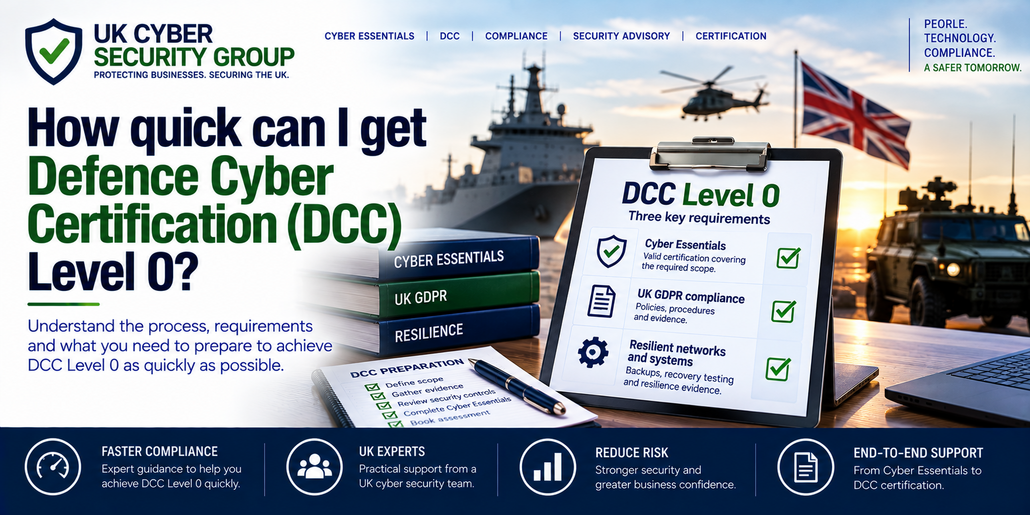
Those three areas are Cyber Essentials, UK GDPR compliance and resilient networks and systems. IASME’s September 2026 Level 0 guidance describes these as clearly defined requirements designed to provide an achievable starting point for organisations of all scales.
UK Cyber Security Group provides Cyber Essentials certification alongside Defence Cyber Certification services, allowing organisations to address the Cyber Essentials baseline and prepare for their DCC assessment through a provider familiar with both schemes.
Why there is no single answer such as three days or two weeks
It would be misleading to promise that every business can achieve DCC Level 0 within a fixed period.
The certification process assesses your real organisation rather than simply processing an application form.
IASME identifies three factors that affect the overall duration: your readiness, whether remediation becomes necessary and Certification Body availability.
Readiness normally has the greatest influence because Level 0 itself is relatively compact.
If your evidence already exists, the assessor has less uncertainty to resolve.
If your scope is incomplete or your resilience arrangements have never received practical testing, more work may be necessary before certification can be awarded.
The quickest route therefore starts before the formal assessment.
Prepare everything the assessor is likely to need and resolve obvious weaknesses first.
Level 0 is deliberately compact
DCC has four assurance levels.
Level 0 contains three controls.
Level 1 contains 101 controls.
Level 2 contains 139 controls.
Level 3 contains 144 controls.
This means Level 0 has a much narrower control requirement than the higher levels.
IASME calls Level 0 the most straightforward place to start and notes that its limited control set allows smaller organisations to demonstrate a recognised minimum baseline of cyber resilience without creating excessive compliance administration.
You should not interpret that simplicity as automatic certification.
The three controls still need implementation and evidence.
Your assessor needs confidence that your answers reflect what actually happens inside the business.
Get Cyber Essentials sorted first
Cyber Essentials is the main prerequisite for Level 0.
IASME confirms that DCC Levels 0 and 1 begin with Cyber Essentials, while Levels 2 and 3 require Cyber Essentials Plus.
If your business already has a current Cyber Essentials certificate covering the appropriate systems, you have removed one of the biggest potential delays.
If you do not yet have Cyber Essentials, start there.
The current Cyber Essentials Requirements for IT Infrastructure are version 3.3, effective from 27 April 2026.
Cyber Essentials focuses on five fundamental technical controls:
- Firewalls
- Secure configuration
- Security update management
- User access control
- Malware protection
These controls create a recognised technical security baseline before DCC considers the wider organisation.
What are the key requirements for achieving Cyber Essentials certification?
To achieve Cyber Essentials, your organisation needs to meet the current requirements across those five technical control areas.
Firewalls should prevent unnecessary connections between your equipment and the internet.
Secure configuration should remove unnecessary functionality and insecure default settings.
Security update management requires supported software and timely vulnerability fixes.
The current v3.3 requirements say relevant fixes should generally be applied within 14 days where they address vulnerabilities identified by the vendor as critical or high risk, have a CVSS v3 base score of 7 or above, or where the vendor does not provide severity information for the weaknesses addressed.
User access control should restrict access according to genuine business requirements.
Malware protection should reduce the likelihood that malicious software can compromise in-scope systems.
If your organisation already manages these controls consistently, completing the Cyber Essentials prerequisite should be easier.
Cyber Essentials scope can determine how quickly DCC progresses
Holding Cyber Essentials does not automatically mean your DCC scope is ready.
This is one of the most important points for organisations trying to achieve Level 0 quickly.
IASME states that DCC scope should include the functions and services necessary for the organisation to operate securely and resiliently. Applicants need a clear scoping statement explaining what falls inside and outside the assessment, how the DCC scope relates to the Cyber Essentials scope and why the boundaries make sense.
Cyber Essentials focuses on relevant internet-connected networks and systems.
DCC considers wider organisational security and resilience.
Any internet-connected systems within your DCC scope that fall within Cyber Essentials requirements need appropriate Cyber Essentials coverage.
Sort this relationship out early.
An unclear scope can lead to assessor questions, clarification and additional evidence requests.
A clear scope removes one of the most common potential delays.
Complete your Statement of Scope before formal assessment
IASME recommends reviewing the organisation’s scope and completing a Statement of Scope before assessment.
Think about what your organisation genuinely depends on.
A small engineering company may depend on Microsoft 365, laptops, cloud storage, its accounts platform, internet connectivity, specialist business software and an external IT provider.
A consultancy might depend heavily on email, document storage, customer systems and cloud communication services.
The scope should cover the essential functions and services needed to operate securely and resiliently.
Avoid defining scope solely around one MOD contract or one employee dealing with Defence work.
The current DCC model looks at broader organisational resilience.
IASME explicitly states that scope should include the essential functions and services required by the organisation rather than only networks handling MOD work.
The second requirement is data protection
Level 0 requires organisations to demonstrate appropriate UK GDPR compliance.
For a prepared organisation, much of this evidence may already exist.
You may already maintain a Data Protection Policy, privacy information, retention arrangements, processing records, supplier agreements and a personal data breach process.
IASME specifically highlights policies, procedures and Data Protection Impact Assessment evidence appropriate to the organisation when describing Level 0.
You do not need to create a huge compliance library solely because you are seeking DCC.
Your evidence should be proportionate and reflect the way your business processes personal data.
For a smaller organisation, concise documents backed by real working processes can be perfectly appropriate.
Check whether your DPIA evidence is ready
Data Protection Impact Assessments can become relevant where processing creates higher risks to individuals.
If your organisation has completed DPIAs, make sure they are current and available.
If no current processing activity requires one, you should still understand why.
An assessor is interested in whether the organisation understands and manages its data protection responsibilities.
Poorly organised evidence can make a straightforward control take longer to assess.
Keep records together.
Make ownership clear.
Ensure employees responsible for data protection understand what the organisation actually does.
The third requirement is resilient networks and systems
Resilience is where many organisations can either save time or create additional work.
IASME’s current Level 0 guidance says applicants should demonstrate practical measures that help systems withstand cyber attacks or failures and recover effectively. It specifically identifies tested restores as an example of useful evidence rather than relying only on a policy claiming backups exist.
This gives businesses a clear preparation target.
Know which services are critical.
Know how you protect them.
Know how you recover them.
Then retain evidence showing that recovery has actually received testing.
A backup report alone does not prove recovery.
A successful restore test provides much stronger evidence.
Test recovery before applying if you want a quicker assessment
Imagine your organisation tells the assessor that cloud backups protect all critical company information.
A reasonable next question is whether those backups have ever been restored successfully.
If nobody knows, the assessor may need further evidence.
If you already have a dated recovery test showing what you restored, who carried out the test, the result and any follow-up actions, the position becomes much clearer.
Do this before assessment.
You do not need an elaborate exercise for every small organisation.
You do need enough evidence to demonstrate that resilience measures are genuine.
Theoretical scoring comes before practical verification
DCC uses two scoring phases.
IASME calls them Theoretical and Practical.
During the Theoretical phase, the applicant explains how the organisation meets the controls and submits evidence. The assessor uses this information to understand the organisation and identify areas needing clarification.
The assessor may allow a Clarification Round.
That gives the applicant an opportunity to update responses or address gaps before practical scoring.
The Practical phase carries the real weight.
During practical scoring, the assessor verifies that the controls operate as described and determines whether the measures meet the required standard.
Good theoretical answers can therefore help the assessment move efficiently, but they cannot replace implementation.
Reduce clarification by making your answers specific
Vague answers create more questions.
If an assessment asks how your organisation maintains Cyber Essentials, do not simply write that your IT provider handles security.
Explain who owns the certification, how renewal receives monitoring and how the organisation knows the covered systems remain compliant.
If the question concerns data protection, explain what process you follow and identify supporting evidence.
For resilience, explain which systems matter, how they receive protection and how recovery has been tested.
Specific answers help the assessor understand your position without repeatedly asking for context.
That can make the process smoother.
Level 0 does not need the Assessment Submission Record used at higher levels
IASME states that applicants need to answer each assessment question, explain how the organisation meets the relevant control and have supporting evidence ready.
However, no Assessment Submission Record is necessary for Level 0.
Assessment Submission Records apply from Levels 1 to 3.
This is another reason Level 0 can represent a relatively straightforward entry point into DCC.
You still need evidence.
You simply avoid some of the additional submission administration associated with the higher levels.
How can I prepare my small business for Cyber Essentials assessment?
Start with an accurate understanding of your IT environment.
Identify your laptops, desktops, servers, mobile equipment, cloud services, relevant applications, network equipment and administrator accounts.
Check that software remains supported.
Review outstanding security fixes.
Make sure firewall rules remain appropriate.
Check whether ordinary users have unnecessary administrative access.
Confirm malware protection operates.
Review cloud authentication.
The NCSC provides free Cyber Essentials preparation resources, including the current question booklet and a readiness tool.
Use those tools before starting formal certification.
For DCC Level 0, also make sure the resulting Cyber Essentials scope aligns adequately with the business-critical environment included in DCC.
What software solutions support compliance with Cyber Essentials standards?
Cyber Essentials does not require one particular product.
Different tools can support different requirements.
Endpoint security can support malware protection.
Endpoint management can help maintain configuration and updates.
Identity platforms can support multi-factor authentication and access controls.
Asset management can help identify forgotten equipment.
Vulnerability management can highlight weaknesses before formal assessment.
Backup platforms can also support wider DCC resilience when they form part of a tested recovery process.
The key issue is not the brand of software.
The organisation must manage the solution properly.
Technology that nobody monitors or maintains provides limited assurance.
Choose your DCC Certification Body early
IASME advises applicants to choose an assured DCC Certification Body as part of initial preparation.
Doing this early can help reduce delays.
Your Certification Body can clarify the assessment process and discuss your proposed scope.
IASME strongly recommends discussing scope with the Certification Body before submission because under-scoping can create difficulties later.
Do not wait until all your documents have been written before raising a complicated scoping question.
A short discussion earlier can prevent significant rework.
The availability of the Certification Body also affects the certification timescale, so engaging early is sensible when you have a target date.
UK Cyber Security Group can support the process
UK Cyber Security Group provides both Cyber Essentials certification and Defence Cyber Certification services.
Its current DCC information describes assessment against defined Defence requirements, evidence review and continuing certification maintenance.
Using a provider familiar with both Cyber Essentials and DCC can be useful because Level 0 depends on the relationship between those schemes.
Your Cyber Essentials certification provides the technical baseline.
Your DCC assessment then considers the wider Level 0 controls and organisational scope.
Keeping these activities coordinated can reduce duplicated work.
Can I renew my Cyber Essentials certification through an online service?
Yes.
Cyber Essentials uses an online verified self-assessment process.
The NCSC describes self-led and supported routes through the scheme, while Certification Bodies can provide additional assistance to organisations that need help understanding or implementing the requirements.
Cyber Essentials certification remains valid for 12 months. Government management information confirms the annual validity period.
That annual renewal matters for DCC.
IASME requires organisations to maintain Cyber Essentials or Cyber Essentials Plus annually while holding DCC.
Do not treat Cyber Essentials as something you obtain once and forget.
Certification speed depends heavily on remediation
A business may begin the process believing it is ready, only for assessment preparation to uncover gaps.
Common examples could include an incomplete Cyber Essentials scope, weak evidence around data protection, outdated resilience documentation or untested recovery arrangements.
The fastest response is not to hide the weakness.
Fix it.
Document the action.
Retain evidence.
Then proceed.
IASME explicitly identifies remediation before practical scoring as one of the main factors affecting certification duration.
The fewer gaps you carry into assessment, the less likely remediation becomes a major delay.
Reuse evidence you already have
Existing compliance work can save substantial effort.
IASME confirms that evidence from other schemes can support a DCC assessment, although another certification does not automatically provide direct compliance with Defence Standard controls.
The MOD also publishes a mapping document linking Defence Standard 05-138 with frameworks including ISO 27001, Cyber Essentials, NIST and other recognised standards.
If your organisation already holds ISO 27001, for example, you may have useful evidence relating to data protection, business continuity, risk and resilience.
Reuse relevant records.
Do not recreate evidence simply because it originally came from another management system.
The assessor still needs to determine whether it satisfies the specific DCC requirement.
Which companies provide Cyber Essentials certification services in the UK?
Cyber Essentials certification is delivered through the official network managed by IASME as the NCSC’s Cyber Essentials Delivery Partner.
The NCSC states that IASME manages a network of more than 400 cyber security organisations that can help businesses prepare for and achieve certification.
UK Cyber Security Group provides Cyber Essentials certification alongside Defence Cyber Certification services.
For a supplier targeting DCC Level 0, choosing support that understands both schemes can make scope alignment and evidence preparation easier.
Always check that the provider is currently authorised for the certification service you require.
Which UK-based firms offer Cyber Essentials consultancy services?
A wide range of UK cyber security organisations provide Cyber Essentials guidance.
Support can include assessment preparation, scope review, technical remediation, endpoint security review, authentication guidance and help understanding the current Cyber Essentials requirements.
The NCSC also operates the Cyber Advisor scheme for organisations seeking assured practical support with the Cyber Essentials controls.
For DCC preparation, look for support that understands the wider organisational requirement as well.
Cyber Essentials alone does not demonstrate your UK GDPR arrangements or prove resilient business systems.
Those additional Level 0 requirements still need evidence.
The MOD’s 31 December 2026 request makes early action important
The Ministry of Defence has asked industry partners to achieve DCC Level 0 by 31 December 2026, including Cyber Essentials for applicable business-critical systems within scope.
That does not mean every organisation should assume it can start immediately before the deadline and receive certification instantly.
IASME itself advises organisations not to leave Level 0 until the end of the year because gathering evidence, refining scope and testing recovery can take time.
Prime contractors may also set earlier internal expectations for suppliers.
Starting earlier gives you room to deal with unexpected gaps without turning certification into an urgent compliance exercise.
Demand may affect assessor availability
Certification Body availability is one of the factors IASME identifies as affecting DCC completion time.
This becomes particularly relevant as organisations work towards the MOD’s December 2026 objective.
IASME’s current directory shows a substantial network of DCC Level 0 Certification Bodies, which gives applicants choice, but individual providers may have different assessment schedules.
If you know you need certification by a particular business deadline, contact your preferred provider early.
Do not wait until every piece of evidence looks perfect before asking about assessment availability.
Current cyber risk provides the reason behind DCC
The focus on Defence supply-chain resilience reflects wider cyber risk across UK businesses.
The Government’s Cyber Security Breaches Survey 2025 to 2026 found that 43 per cent of businesses identified a cyber breach or attack during the previous 12 months, equivalent to approximately 612,000 UK businesses.
Medium businesses reported a rate of 65 per cent and large businesses 69 per cent.
Defence organisations depend on suppliers that can continue operating securely.
A supplier can create operational risk even when it does not directly handle particularly sensitive Defence information.
That explains why the current Defence Standard takes a broader organisational resilience approach.
Cyber Essentials is already widely established
Cyber Essentials adoption has continued to grow.
Government data updated in September 2026 shows that 61,430 Cyber Essentials certificates were awarded during the twelve months from July 2025 to June 2026. Of those, 46,245 were Cyber Essentials and 15,185 were Cyber Essentials Plus.
For many Defence suppliers, that means the technical foundation required by Level 0 may already exist.
If you already hold the right Cyber Essentials coverage, your Level 0 preparation can concentrate more heavily on scope, data protection and resilience evidence.
A practical fast-track preparation route
If speed matters, work in a logical order.
First, confirm that Level 0 is the certification level you need.
The MOD or your Prime normally determines the required level for a contract.
Second, make sure Cyber Essentials is current.
Third, define your DCC scope and map it against Cyber Essentials.
Fourth, organise your UK GDPR evidence.
Fifth, identify your critical services and check resilience arrangements.
Sixth, carry out a recovery test where appropriate and retain the evidence.
Seventh, select your Certification Body and discuss scope early.
Eighth, answer the Level 0 questions clearly and have evidence immediately available.
Finally, respond promptly if the assessor requests clarification.
This approach cannot guarantee a particular completion date, but it removes many avoidable delays.
Do not confuse fast certification with weak evidence
Trying to move quickly should not mean cutting corners.
DCC is not a self-assessment scheme. IASME explicitly confirms that no DCC level operates through self-assessment alone.
The practical scoring phase verifies whether the organisation really implements the controls it describes.
Good preparation makes this verification easier.
Poor evidence makes it harder.
A concise record backed by genuine practice is better than a long document created solely for assessment.
Maintaining DCC also needs planning
Once you achieve Level 0, the work does not simply stop.
IASME requires annual attestation confirming that the controls remain maintained and that the certification scope has not significantly changed.
Cyber Essentials needs annual recertification.
Full DCC recertification takes place every three years.
Set reminders as soon as certification is achieved.
Keep Cyber Essentials current.
Retain resilience test evidence.
Review major changes.
Maintain data protection arrangements.
This makes future attestation and recertification much easier.
So, how quickly can you achieve DCC Level 0?
There is no official number of days or weeks.
IASME deliberately does not set one because organisations enter the process with very different levels of readiness.
However, Level 0 is the most compact DCC level and has only three controls.
A prepared organisation that already holds appropriate Cyber Essentials certification, has a clear scope and can readily demonstrate UK GDPR compliance and practical resilience should face a considerably simpler process than an organisation starting from scratch.
The biggest delays are likely to come from gaps rather than from the number of Level 0 controls.
Unclear scope takes time.
Missing Cyber Essentials takes time.
Weak data protection evidence takes time.
Untested recovery can take time.
Remediation takes time.
Certification Body availability also matters.
Prepare those areas before formal assessment and you put the organisation in the strongest possible position for a smooth certification journey.
UK Cyber Security Group provides Cyber Essentials certification and Defence Cyber Certification services, allowing organisations to address the technical baseline and DCC requirements through a provider familiar with both processes.
For Defence suppliers working towards the MOD’s 31 December 2026 Level 0 objective, the sensible approach is to start while there is still time to resolve weaknesses properly.
The quickest route is not skipping requirements.
It is arriving at the assessment genuinely ready.
UK Cyber Security Group Ltd is here to help
Please check out our Free Cyber Insurance
Other blog posts, Your ISO 27001 Questions Answered, Get ISO 27001 Certified ,
If you would like to know more, do get in touch as we are happy to answer any questions. Looking to improve your cybersecurity but not sure where to start? Begin by getting certified in Cyber Essentials, the UK government’s scheme that covers all the technical controls that will provide the protection that you need to help guard against criminal attacks. Or just get in touch by clicking contact us


