
How to evidence Risk Management for Defence Cyber Certification (DCC) Level 0?
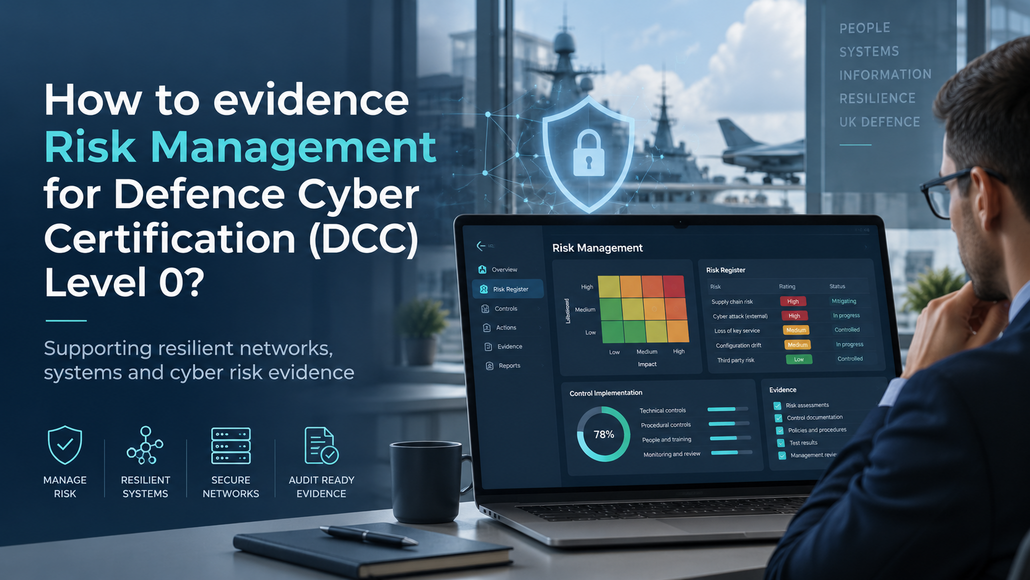
How to evidence Risk Management for Defence Cyber Certification (DCC) Level 0?
Risk management plays an important role in helping businesses demonstrate that they understand their cyber security exposure and can protect the systems needed to operate reliably.
For organisations working within the UK defence supply chain, effective risk management also supports preparation for Defence Cyber Certification (DCC).
However, businesses approaching DCC Level 0 often have questions about what risk management evidence they need, whether a formal risk register is mandatory and how to demonstrate that security risks receive appropriate attention.
The answer is more straightforward than many organisations expect.
Defence Cyber Certification Level 0 focuses on three mandatory controls: Cyber Essentials certification, UK GDPR compliance and resilient networks and systems.
Although Level 0 does not contain a separate mandatory risk-management control, having a documented approach to identifying and managing risks can provide valuable supporting evidence.
This is particularly relevant to the requirement for resilient networks and systems.
An organisation needs to understand which systems support its critical business functions, what could cause those systems to fail and how it will continue operating or recover following disruption.
A practical risk assessment can help demonstrate that understanding.
The Ministry of Defence established Defence Cyber Certification to strengthen security and resilience across the UK defence supply chain. The scheme uses Defence Standard 05-138 Issue 4, which establishes the relevant security controls for different levels of assessed cyber risk.
UK Cyber Security Group Ltd provides Cyber Essentials certification and Defence Cyber Certification services to organisations seeking to demonstrate compliance with the required Defence standards.
By maintaining clear risk records, documenting important security decisions and collecting appropriate operational evidence, businesses can approach DCC Level 0 with greater confidence.
Understanding risk management within Defence Cyber Certification
Cyber risk management involves identifying potential security events, understanding their possible consequences and deciding how an organisation should respond.
These events may affect information confidentiality, system availability, data integrity or the organisation’s ability to deliver its services.
For a defence supplier, cyber risk can also affect contractual commitments and operational reliability.
Consider a small engineering company that produces components for a larger Defence contractor.
The company might depend on Microsoft 365, engineering software, employee laptops, customer specifications, cloud storage and an external IT support provider.
If ransomware disrupts its systems, the organisation could lose access to important documents and experience delays in fulfilling customer orders.
A risk assessment helps identify that possibility.
Management can then consider which controls reduce the likelihood of disruption and which recovery measures limit its impact.
This approach provides a practical foundation for cyber resilience.
What does DCC Level 0 actually require?
Defence Standard 05-138 Issue 4 establishes four Defence Cyber Certification levels.
Level 0 provides the foundation for organisations with a basic assessed cyber risk profile.
It contains three controls:
Control 0001: Cyber Essentials
The organisation must hold Cyber Essentials certification covering the appropriate scope and commit to maintaining the certification.
Control 2314: UK GDPR compliance
The organisation must ensure that its personal data processing complies with the applicable UK GDPR requirements.
Control 2500: Resilient networks and systems
The organisation must incorporate resilience against cyber attacks and system failures into the design, implementation, operation and management of systems supporting business functions and protecting information.
These requirements come from the official Defence Standard 05-138 Issue 4.
They establish the actual Level 0 assessment baseline.
Organisations should avoid assuming that every control appearing elsewhere in the Defence Standard automatically applies at Level 0.
Is a formal risk register mandatory for Level 0?
A formal standalone cyber risk register is not explicitly required by the three Level 0 controls.
This is an important distinction.
Defence Standard 05-138 includes specific governance and risk-management controls within its higher assurance levels.
For example, Control 1200 addresses risk management more directly and applies from Level 1 upwards.
However, Control 1200 does not form part of the three mandatory Level 0 controls.
A business preparing for Level 0 should therefore concentrate on demonstrating the three applicable requirements rather than automatically creating documentation intended for a higher assessment level.
Nevertheless, maintaining a concise risk register can be extremely useful.
It helps organisations explain which systems matter, what could disrupt them and what actions support resilience.
The register also provides a practical way to demonstrate that management has considered important cyber risks rather than relying entirely on general statements.
Start by defining your DCC assessment scope
Before documenting risks, establish what the DCC assessment covers.
DCC uses an organisation-wide approach to cyber resilience.
The scope should reflect the processes, systems, information and business functions necessary for the organisation to operate securely and deliver its services.
This is broader than focusing only on one computer used for a Ministry of Defence contract.
According to IASME’s DCC guidance, the scope must include the relevant processes, systems and business operations required for the organisation to function securely and resiliently.
IASME also recommends discussing scope with the selected Certification Body before formal submission.
Identify important business functions
Begin by considering what your organisation needs to continue operating.
This may include customer communications, order processing, engineering activity, document management, financial administration and delivery services.
Next, identify the information systems supporting those functions.
An organisation might depend on cloud services, servers, applications, network connections, employee devices and external suppliers.
These dependencies help determine which security risks require attention.
The scope should remain accurate and proportionate.
A small organisation does not need an unnecessarily complicated scoping document, but it should understand the systems and services on which its operations depend.
Create a practical cyber risk assessment
A cyber risk assessment helps an organisation understand possible threats to its information and systems.
It should consider realistic scenarios rather than simply produce a long collection of generic concerns.
For example, instead of recording a risk as “cyber attack”, a business could describe the possibility that compromised employee credentials allow unauthorised access to confidential customer documents.
Another risk might involve the failure of a cloud service preventing employees from accessing operational information.
A third might concern a ransomware incident affecting shared files and disrupting delivery commitments.
Each risk should describe what could happen and why it matters.
What should the assessment record?
A useful risk assessment can record the relevant business activity, affected system, potential security event, likelihood, business impact, existing safeguards and any further action required.
Assign a person responsible for managing the risk.
Where useful, record an assessment of the remaining exposure after safeguards operate.
For example:
Risk: Loss of access to critical customer documentation following a ransomware incident.
Affected service: Cloud document storage.
Business impact: Employees cannot access specifications needed to complete customer orders.
Existing safeguards: Access controls, endpoint protection, backups and security monitoring.
Further action: Review recovery arrangements and demonstrate that important documents can be restored.
Risk owner: Operations Manager.
Evidence: Backup reports, restore test records and relevant security management information.
This example creates a clear relationship between the identified risk and the evidence supporting the organisation’s resilience.
Keep the assessment proportionate
DCC Level 0 is intended to provide an achievable security baseline.
IASME’s September 2026 guidance explains that smaller organisations do not need extensive policy documentation simply to demonstrate compliance.
Assessors want to understand whether the organisation has considered the relevant requirements and implemented suitable measures.
A short, accurate assessment supported by evidence can therefore be more useful than a complicated register containing dozens of risks nobody reviews.
Focus on important business services and credible threats.
The objective is to support better decisions and provide useful evidence of resilience.
Understanding likelihood and impact
Risk assessments commonly evaluate likelihood and impact.
Likelihood concerns how realistically a security event could occur.
Impact concerns the possible consequences for the organisation.
For example, an interruption to an unimportant internal application may create limited disruption.
However, losing access to the only system used to manage customer orders could affect the company’s ability to deliver services.
The organisation should consider existing safeguards when making these decisions.
A business with reliable backups and demonstrated recovery capability may face a different level of disruption from one that has never tested its recovery arrangements.
A simple scoring approach can support consistent decisions.
However, Level 0 does not prescribe a particular risk matrix.
The method should help management understand the risks rather than create unnecessary complexity.
Risk ownership demonstrates accountability
A risk assessment becomes more useful when someone owns each important risk.
The risk owner should understand its business consequences and be able to arrange or escalate appropriate action.
For example, the Operations Director may own the risk of customer service disruption.
An IT provider may operate the backups and technical safeguards that reduce the exposure.
Both contribute to risk management, but their responsibilities differ.
The business owner should understand the impact of disruption.
The technical provider should be able to demonstrate that relevant controls operate.
Documenting these responsibilities can make it easier to answer questions during DCC assessment.
The strongest Level 0 risk evidence concerns resilience
Control 2500 is particularly important when considering risk management evidence.
The Defence Standard requires suppliers to build resilience against cyber attacks and system failure into the way they manage systems that support business functions and protect information.
This goes beyond purchasing backup software.
An organisation should understand how important systems remain operational or recover following disruption.
Useful supporting evidence may include critical systems records, resilience assessments, backup information, recovery arrangements and documented recovery testing.
IASME specifically identifies tested restores as an example of meaningful Level 0 evidence.
A policy saying that backups exist provides less assurance than evidence showing that the organisation has successfully recovered information.
Identify your critical systems
A Critical Systems Register can provide useful supporting evidence for DCC Level 0.
The register should identify important systems and explain how they support business operations.
For example, a supplier might depend on Microsoft 365 for communications, a cloud platform for customer records and specialist software for production planning.
Each dependency should receive appropriate consideration.
The business should understand what would happen if the system became unavailable.
It should also know who owns the system and who manages recovery.
A practical record can include the system name, business purpose, owner, external provider, main dependency, potential impact of failure and recovery arrangements.
This information helps connect risk management with operational resilience.
Backups provide evidence, but recovery provides assurance
Many organisations assume that successful backup reports automatically prove resilience.
Backups are important, but the ability to recover information is equally significant.
A backup system may report successful activity while the organisation remains uncertain about how long recovery will take or whether the information can be restored properly.
Recovery testing helps address that uncertainty.
For DCC Level 0, a restore test record can provide valuable evidence.
The record might identify the system tested, the information recovered, the date, the responsible person, the result and any problems discovered.
Management should address significant weaknesses identified during testing.
For example, a test may reveal that restoring critical customer documents takes longer than expected.
The business can then review its arrangements and decide whether improvement is necessary.
This demonstrates practical risk management rather than relying only on written assurances.
Evidence business continuity risks
Cyber incidents can affect more than individual computers.
An organisation may depend on internet connectivity, cloud applications, external IT providers and employees with specialist knowledge.
If one of these becomes unavailable, important business activities could stop.
A business continuity risk assessment can help identify those dependencies.
For example, a supplier may recognise that a prolonged internet outage could prevent staff accessing customer orders.
The organisation might consider alternative working arrangements, communication methods and recovery responsibilities.
The resulting records can support the resilience requirement.
Level 0 does not automatically demand an extensive business continuity management system.
However, practical arrangements should match the importance of the business functions involved.
Supplier risk management supports organisational resilience
Most businesses depend on external suppliers.
These might include cloud hosting providers, managed IT businesses, telecommunications companies, software vendors and backup providers.
A supplier failure can affect the organisation even when its own systems remain secure.
For example, an outage affecting a critical cloud platform could prevent employees from accessing information needed for delivery.
The business should understand that dependency.
A simple supplier risk record can identify the service, business owner, potential impact of failure and any relevant contingency arrangements.
Consider whether supplier agreements address appropriate security and availability responsibilities.
Where a supplier manages backups or security monitoring, obtain evidence that supports the organisation’s claims.
The aim is to understand important dependencies and demonstrate reasonable management of the associated risks.
Risk management also supports UK GDPR compliance
Control 2314 requires organisations to meet applicable UK GDPR requirements.
Personal data processing can create risks to individuals as well as risks to the business.
For example, unauthorised disclosure of employee information could cause distress, financial harm or loss of confidentiality.
An organisation should therefore understand what personal information it processes and the safeguards protecting it.
A Data Protection Impact Assessment, known as a DPIA, may be required when processing is likely to create high risk to individuals’ rights and freedoms.
Not every processing activity requires a full DPIA.
However, documenting a suitable screening decision can help demonstrate that the organisation has considered its obligations.
The Information Commissioner’s Office provides guidance on determining when a DPIA is required.
For DCC Level 0, relevant DPIA records and supporting data protection procedures can help demonstrate how the organisation manages personal data risks.
A cyber risk assessment does not replace a DPIA
Businesses should distinguish between risks to their operations and risks to individuals.
A general cyber risk assessment might consider the impact of losing access to an employee management system.
The main concern could involve disruption to payroll or administration.
A DPIA examines potential harm to individuals arising from personal data processing.
The same system may therefore appear in both assessments.
However, the assessments answer different questions.
Where a DPIA is legally required, a general IT risk register does not automatically satisfy the obligation.
Organisations should keep the relevant records connected without assuming that one document replaces every other assessment.
Cyber Essentials provides the technical risk baseline
Cyber Essentials certification is mandatory for DCC Level 0.
The scheme focuses on reducing exposure to common cyber security threats through five fundamental technical controls.
These controls provide an established starting point for risk management.
A valid Cyber Essentials certificate demonstrates that the organisation has completed the relevant verified assessment.
However, the certificate’s scope must appropriately cover the applicable systems within the DCC boundary.
The organisation should maintain sufficient information to explain the relationship between its Cyber Essentials and DCC scopes.
The current Cyber Essentials Requirements for IT Infrastructure are version 3.3, effective from 27 April 2026.
Further guidance is available through the National Cyber Security Centre.
What are the key requirements for achieving Cyber Essentials certification?
Cyber Essentials focuses on five fundamental control areas.
Firewalls protect systems against unnecessary and unauthorised network connections.
Secure configuration reduces weaknesses caused by insecure defaults and unnecessary functionality.
Security update management helps ensure relevant software remains supported and receives appropriate vulnerability fixes.
User access control restricts access according to legitimate business needs and limits unnecessary administrative privileges.
Malware protection reduces the risk of malicious software compromising systems.
These requirements address common cyber attack methods.
For DCC Level 0, maintaining Cyber Essentials provides important evidence of technical security arrangements.
However, Cyber Essentials does not replace the separate requirements concerning UK GDPR compliance and resilient networks and systems.
Risk management should connect with Cyber Essentials evidence
The information gathered for Cyber Essentials can also help support a wider understanding of cyber risk.
For example, asset records can identify which equipment supports critical business processes.
Security update management reports can help reveal weaknesses affecting important systems.
Account reviews may identify unnecessary administrator privileges.
Endpoint security reporting can provide information about malware protection.
These records can inform a practical risk assessment.
However, the organisation should avoid duplicating technical information unnecessarily.
Where existing management systems already provide reliable evidence, use those records rather than recreating them manually.
How can I prepare my small business for Cyber Essentials assessment?
Small businesses should begin by identifying their relevant IT environment.
Understand which devices employees use, which cloud services support business operations and which accounts have privileged access.
Review operating systems and applications to confirm they remain supported.
Check security updates, firewall arrangements and malware protection.
Consider remote employees and relevant mobile equipment.
The business should also understand its cloud authentication arrangements and ensure that access controls meet the current scheme requirements.
An accurate inventory provides a useful starting point.
For DCC Level 0, the organisation should then identify which of these systems support critical business functions.
This creates a clear relationship between Cyber Essentials preparation and wider resilience assessment.
What software solutions support compliance with Cyber Essentials standards?
Cyber Essentials does not require every business to use identical software products.
Different technologies can support the relevant security controls.
Endpoint protection can help defend against malware.
Device management can support consistent security settings and security updates.
Identity management can support authentication and appropriate access control.
Vulnerability management tools can identify weaknesses requiring attention.
Asset management platforms can help organisations understand which equipment and applications remain in use.
Security monitoring can provide information about suspicious activity.
For businesses preparing for DCC, backup and recovery services may also provide evidence relevant to resilience.
The important point is not which brand the organisation uses.
The technology needs to operate effectively and support the required security outcomes.
Document how management responds to risks
Identifying risks is only useful when the organisation can respond appropriately.
A practical risk register should help management decide which concerns require action.
For example, an assessment might identify that an important cloud platform lacks a proven recovery arrangement.
Management could assign an employee to review the service dependency and obtain suitable recovery evidence.
Another risk may involve unsupported software affecting a critical business application.
The organisation would need to understand the exposure and determine appropriate action.
Where a risk receives acceptance, management should understand the reason and whether that decision remains compatible with legal, contractual and certification requirements.
A risk cannot simply be accepted as a way to avoid a mandatory control.
Documenting decisions can help demonstrate that the organisation manages security issues deliberately.
Maintain evidence of completed actions
An action plan provides useful direction, but completion evidence provides greater assurance.
For example, a risk register may identify the need to review backup recovery arrangements.
The organisation should then retain the relevant review or test evidence.
An identified supplier dependency might lead to a documented review of alternative arrangements.
A concern about outdated software might lead to an updated asset record and evidence of remediation.
This creates traceability.
The assessor can understand what the organisation identified, what it decided and what it actually did.
That relationship is more valuable than a risk register containing completed tasks without supporting records.
What evidence could a DCC Level 0 assessor request?
IASME explains that applicants must answer the relevant assessment questions, describe how they meet each control and provide supporting evidence.
For Level 0, the evidence should demonstrate the actual three mandatory controls.
Useful supporting information may include:
- Current Cyber Essentials certificate
- Statement of Scope
- Cyber Essentials and DCC scope mapping
- Critical systems information
- Practical cyber risk assessments
- Risk ownership and action records
- Resilience arrangements
- Backup reports
- Recovery testing evidence
- Relevant supplier dependency records
- Data Protection Policy
- DPIA screening and completed DPIAs where required
- Personal data handling procedures
- Management review or approval records where relevant
- Evidence that outstanding security actions receive attention
This is a practical preparation list, not a requirement to create fifteen separate documents.
An assessor may accept different evidence where it adequately demonstrates the relevant control.
The most important principle is that the evidence matches the claims made during assessment.
DCC Level 0 does not require an Assessment Submission Record
IASME’s current DCC resources confirm that no Assessment Submission Record is necessary for Level 0.
That document applies to Levels 1 to 3.
Applicants still need to answer the assessment questions and make supporting evidence available.
This distinction is useful for smaller organisations.
The assessment should remain proportionate rather than encouraging unnecessary paperwork.
A concise risk assessment and clear operational evidence can provide useful support without attempting to replicate the more extensive documentation associated with higher DCC levels.
Understanding the DCC assessment process
Defence Cyber Certification involves independent assessment through an IASME-assured Certification Body.
IASME describes two scoring phases: Theoretical and Practical.
During the Theoretical phase, the organisation explains its security arrangements and provides relevant evidence.
The assessor reviews the information and may request clarification.
The Practical phase examines whether the organisation actually operates the controls as described.
This means documentation alone is insufficient.
If a business claims to maintain effective recovery arrangements, the assessor may want evidence demonstrating that those arrangements work.
If the organisation describes UK GDPR processes, it should be able to support those statements with appropriate records.
The risk assessment can help explain the context, but the evidence must demonstrate the relevant controls.
Reuse existing risk management records
Many defence suppliers already maintain some form of information security or business risk register.
Organisations holding ISO 27001, IASME Cyber Assurance or other recognised certifications may also have relevant evidence.
IASME confirms that evidence from other security schemes can support DCC assessment.
However, another certification does not automatically establish compliance with every Defence Standard control.
The organisation must still demonstrate that its existing records satisfy the specific DCC requirement.
For example, an ISO 27001 risk assessment may help explain which systems support critical business services.
Recovery test records may provide evidence for resilience.
Data protection records may support UK GDPR compliance.
Reusing suitable evidence can reduce administration while maintaining a consistent approach to security.
Keep risk assessments current
Business risks change over time.
An organisation may introduce a new cloud service, change its IT provider, recruit employees or adopt new software.
A significant cyber incident could also reveal weaknesses that were not previously understood.
The organisation should therefore review risk information when important changes occur.
For example, moving customer documentation to a new cloud platform may create different supplier dependencies.
The business should consider whether existing access controls and recovery arrangements remain appropriate.
A risk review does not need to become a lengthy exercise.
It should confirm whether the previous assessment remains accurate and whether further action is necessary.
Annual DCC maintenance requires continued attention
DCC certification is not a one-off activity.
IASME requires certificate holders to maintain the applicable Cyber Essentials certification annually.
Organisations must also complete annual DCC attestation and full DCC recertification every three years.
The annual attestation includes confirming that relevant controls remain maintained and that the scope has not changed significantly.
Maintaining current risk and resilience records can help organisations support these ongoing responsibilities.
For example, a business that regularly reviews critical systems and recovery arrangements will have better evidence when confirming that its security controls remain effective.
The aim is to maintain resilience as part of normal business operations.
Why cyber risk management matters to UK businesses
Cyber threats remain a significant concern for organisations across the UK.
The UK Government’s Cyber Security Breaches Survey 2025/2026 found that 43 per cent of UK businesses identified a cyber security breach or attack during the previous twelve months.
This represents approximately 612,000 businesses.
The figure increased to 65 per cent among medium businesses and 69 per cent among large businesses.
Phishing remained the most commonly identified attack, affecting 38 per cent of businesses.
Despite this exposure, only 30 per cent of businesses reported completing a cyber security risk assessment during the previous twelve months.
The survey also found that 15 per cent reviewed cyber risks associated with immediate suppliers, while only 6 per cent reviewed their wider supply chains.
These figures highlight the importance of understanding business dependencies and cyber risk.
For Defence suppliers, a disruption can affect more than the individual organisation.
It may also affect customers and other businesses relying on its products or services.
The December 2026 Defence objective
The Ministry of Defence has asked industry partners to achieve DCC Level 0 by 31 December 2026.
This includes obtaining Cyber Essentials for applicable business-critical systems within scope.
The request reflects the importance of strengthening resilience across Defence supply chains.
However, suppliers should still check the specific requirements associated with their contracts.
The required DCC level may depend on the Cyber Risk Profile determined by the MOD or a prime contractor.
Organisations should also avoid assuming that Level 0 automatically satisfies every future contractual security requirement.
Some contracts may require a higher level of assurance.
Preparing clear risk and resilience evidence now can help establish a foundation for continued improvement.
Can I renew my Cyber Essentials certification through an online service?
Yes.
Cyber Essentials uses an online verified self-assessment process delivered through authorised Certification Bodies.
Organisations can complete their assessment and renew certification through the official scheme.
Cyber Essentials certificates remain valid for twelve months.
For DCC Level 0, annual renewal matters because the technical baseline must remain in place.
Businesses should review their IT environment before renewal rather than relying on outdated information.
New devices, cloud services, employees and applications can affect certification scope.
Maintaining accurate security and risk records throughout the year can make the renewal process easier.
Which companies provide Cyber Essentials certification services in the UK?
Cyber Essentials certification is delivered through Certification Bodies licensed within the official scheme administered by IASME.
These organisations assess applications and provide certification according to the scheme requirements.
UK Cyber Security Group Ltd offers Cyber Essentials certification and wider cyber security compliance services.
The company also appears in IASME’s DCC Level 0 Certification Body directory.
Businesses pursuing Defence Cyber Certification may benefit from working with a provider familiar with both Cyber Essentials and DCC.
This can help simplify scope alignment and preparation for assessment.
Further information is available through UK Cyber Security Group’s Cyber Essentials service.
Which UK-based firms offer Cyber Essentials consultancy services?
UK businesses can obtain Cyber Essentials support from specialist cyber security consultancies, managed IT providers and qualified compliance professionals.
Useful support may include reviewing assessment scope, understanding technical controls, identifying security weaknesses and preparing evidence.
For DCC Level 0, organisations may also need assistance with business resilience, data protection and the relationship between Cyber Essentials and DCC scope.
UK Cyber Security Group provides Cyber Essentials certification and Defence Cyber Certification services for organisations preparing for Defence supply-chain security requirements.
Its Defence Cyber Certification service provides further information about the certification process.
When selecting support, confirm that the provider understands the actual DCC controls rather than assuming that every higher-level requirement applies at Level 0.
A practical risk management evidence checklist
Before your DCC Level 0 assessment, ask whether your organisation can confidently demonstrate the following.
Understanding business risk
Do we know which business functions are critical?
Have we identified the systems and suppliers supporting them?
Do we understand the main cyber threats affecting those services?
Assessing risk
Have we considered the likelihood and impact of important security events?
Can we explain how those events could affect our ability to operate?
Have we identified who owns significant risks?
Managing risk
Do we understand which safeguards reduce our exposure?
Have we identified any necessary additional actions?
Can we demonstrate that completed actions actually happened?
Demonstrating resilience
Do we maintain appropriate backup and recovery arrangements?
Have we tested recovery where suitable?
Can we explain how important services would recover following disruption?
Supporting DCC Level 0
Is our Cyber Essentials certification current?
Does its scope align appropriately with the DCC boundary?
Can we demonstrate UK GDPR compliance?
Do we have relevant resilience evidence?
Can our Certification Body readily examine the information supporting our answers?
An organisation that can answer these questions clearly has established a useful foundation for demonstrating the Level 0 controls.
Effective risk management strengthens Defence cyber resilience
Risk management should help organisations make informed decisions about their information security.
For Defence Cyber Certification Level 0, it provides useful supporting evidence rather than representing a separate mandatory control.
The formal Level 0 requirements remain Cyber Essentials, UK GDPR compliance and resilient networks and systems.
A practical approach to risk management helps explain how those requirements support the organisation’s operations.
It identifies important systems and dependencies.
It considers what could disrupt them.
It helps management decide which safeguards matter.
It also supports recovery planning and evidence collection.
For smaller organisations, the process should remain proportionate.
A clear risk register, accurate critical systems information and genuine resilience evidence can provide greater value than an extensive set of documents created only for assessment.
The strongest evidence demonstrates that the business understands its security exposure and takes reasonable action to manage it.
UK Cyber Security Group Ltd provides Cyber Essentials certification and Defence Cyber Certification services to organisations working towards the relevant Defence requirements.
By bringing together accurate scope information, Cyber Essentials evidence, appropriate data protection records, resilience arrangements and practical risk management, businesses can approach DCC Level 0 in a more organised way.
The objective is not simply to complete another compliance exercise.
It is to understand what matters to the business, reduce avoidable security exposure and demonstrate that important systems and information remain appropriately protected.
That approach supports DCC Level 0 preparation while building a stronger foundation for long-term cyber resilience across the UK defence supply chain.
UK Cyber Security Group Ltd is here to help
Please check out our Free Cyber Insurance
Other blog posts, Your ISO 27001 Questions Answered, Get ISO 27001 Certified ,
If you would like to know more, do get in touch as we are happy to answer any questions. Looking to improve your cybersecurity but not sure where to start? Begin by getting certified in Cyber Essentials, the UK government’s scheme that covers all the technical controls that will provide the protection that you need to help guard against criminal attacks. Or just get in touch by clicking contact us


