
What is needed for Risk Management in Defence Cyber Certification (DCC) Level 0?
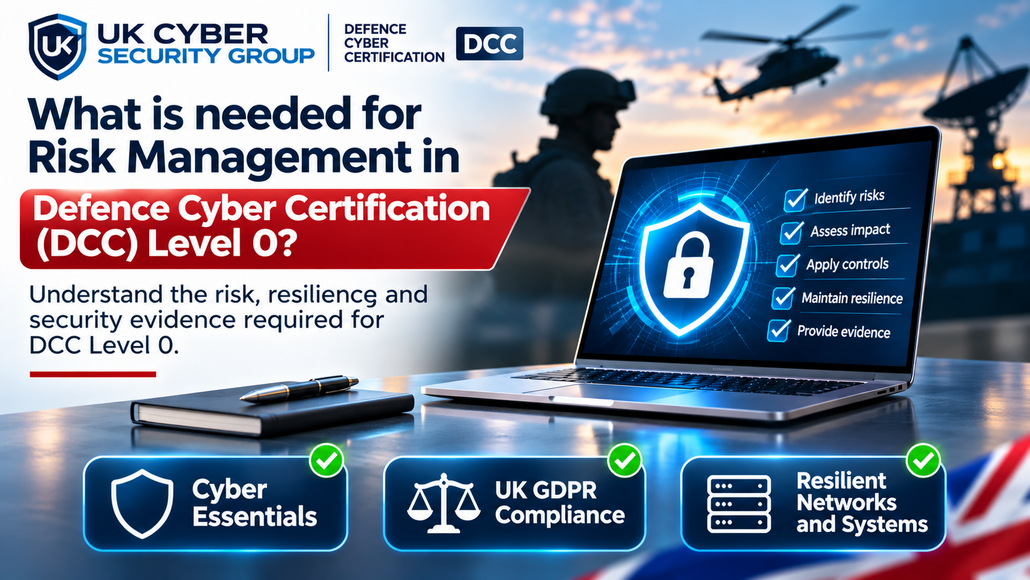
What is needed for Risk Management in Defence Cyber Certification (DCC) Level 0?
Risk management plays an important role in protecting businesses against cyber security threats, operational disruption and the loss of sensitive information.
For organisations working within the UK defence supply chain, understanding cyber security risks is especially important. Suppliers must protect their own operations while maintaining the security and reliability of services supporting Ministry of Defence (MOD) contracts.
Defence Cyber Certification (DCC) provides a structured approach to demonstrating that organisations meet relevant cyber security requirements.
However, businesses preparing for DCC Level 0 often have questions about risk management.
Do they need a formal risk register? What information should they document? How can they demonstrate that they understand their cyber security risks? What evidence will an assessor expect?
The most important point is that DCC Level 0 does not contain a separate mandatory risk management control.
Instead, Level 0 focuses on three requirements: Cyber Essentials certification, UK GDPR compliance, and resilient networks and systems.
Although formal risk management requirements apply at higher DCC levels, a practical approach to identifying and managing risks can provide valuable supporting evidence for Level 0.
This is particularly relevant to demonstrating how the organisation maintains the resilience of important business systems.
UK Cyber Security Group Ltd provides Cyber Essentials certification and Defence Cyber Certification services for UK organisations preparing to meet the relevant defence security requirements.
As an IASME-assured Certification Body, UK Cyber Security Group helps businesses understand their certification responsibilities, prepare appropriate evidence and demonstrate compliance with applicable controls.
Organisations can explore its Defence Cyber Certification services and obtain guidance on preparing for assessment.
The most effective approach to Level 0 risk management is to keep the process practical, proportionate and focused on genuine business risks.
Understanding risk management within Defence Cyber Certification
Cyber security risk management involves identifying events that could compromise important information, disrupt business operations or affect the reliability of essential systems.
The organisation then considers the possible consequences and determines how to manage the exposure.
For example, a small engineering company supplying components to a defence contractor might depend on cloud storage, customer specifications, production software and external IT support.
If ransomware prevents employees from accessing production information, the business may struggle to complete customer orders.
A risk assessment helps management understand that possibility.
The company can then consider the safeguards that reduce the likelihood of disruption and the recovery arrangements that limit its impact.
Effective risk management therefore supports more than cyber security compliance.
It helps businesses protect their ability to operate.
Why risk management matters to defence suppliers
The UK defence supply chain includes businesses with very different operational responsibilities.
Some suppliers manufacture specialist equipment.
Others provide consultancy, maintenance, logistics, engineering or digital services.
Regardless of their activities, these organisations often depend on information systems and external providers.
A cyber incident affecting one supplier can create disruption for customers and other organisations that depend on its services.
Risk management helps businesses understand those dependencies and make informed decisions about appropriate safeguards.
What does DCC Level 0 actually require?
The Ministry of Defence established Defence Cyber Certification to strengthen security and resilience across its supply chain.
The scheme uses Defence Standard 05-138 Issue 4, which defines cyber security controls for four levels of assessed risk.
The four DCC levels are:
- Level 0: Basic security, containing three controls.
- Level 1: Foundational security, containing 101 controls.
- Level 2: Advanced security, containing 139 controls.
- Level 3: Expert security, containing 144 controls.
The applicable level depends on the relevant Cyber Risk Profile and contractual requirements.
Level 0 provides the starting point for suppliers with a basic assessed cyber risk profile.
The three mandatory Level 0 controls
Control 0001: Cyber Essentials
The organisation must hold Cyber Essentials certification covering the required scope and commit to maintaining certification throughout the relevant contract.
Control 2314: UK GDPR compliance
The organisation must ensure that its personal data processing complies with applicable UK GDPR requirements.
Control 2500: Resilient networks and systems
The organisation must incorporate resilience against cyber attacks and system failures into the design, operation and management of systems supporting business functions and protecting information.
These requirements appear in the official Defence Standard 05-138 Issue 4.
Businesses preparing for Level 0 should focus on demonstrating these three requirements rather than assuming that every control appearing elsewhere in the standard is mandatory.
Is a formal risk management process mandatory for DCC Level 0?
This is one of the most important distinctions for organisations approaching certification.
Defence Standard 05-138 includes a specific risk management requirement under Control 1200.
That control requires organisations to identify, assess, understand and address security risks through an appropriate organisational approach.
However, Control 1200 applies to DCC Levels 1, 2 and 3, not Level 0.
The standard also includes additional risk management requirements at higher assurance levels.
Therefore, Level 0 does not explicitly require a formal standalone cyber risk register or the full risk management processes associated with higher DCC levels.
Why maintain a risk register anyway?
Although the three Level 0 controls do not explicitly require a separate risk register, maintaining one can help businesses demonstrate that they understand their security exposure.
For example, a concise register can identify important systems, potential disruption scenarios, existing safeguards and any necessary improvements.
This information may help explain how the organisation meets Control 2500 concerning resilient networks and systems.
A risk register can also support management decisions and help the business prepare for higher DCC levels in the future.
However, a risk register alone does not establish compliance.
The organisation must demonstrate that its actual security and resilience arrangements meet the applicable Level 0 controls.
Begin by understanding your DCC assessment scope
Before considering risk management evidence, businesses should establish what their DCC assessment covers.
The scope of Defence Cyber Certification takes an organisation-wide approach to cyber resilience.
It considers the systems, processes and business operations necessary for an organisation to function securely and reliably.
This goes beyond protecting a single computer or document used for a defence contract.
According to IASME’s DCC guidance, organisations should include all relevant processes, systems and business activities necessary for secure and resilient operations.
IASME also recommends discussing assessment scope with the selected Certification Body before formal submission.
Identify the business functions that matter most
Start by considering which activities your organisation must maintain to operate effectively.
These might include customer communications, order processing, engineering activities, production planning, document management and financial administration.
Next, identify the systems supporting those functions.
For example, a supplier may depend on Microsoft 365 for communication, a cloud platform for customer records and specialist software for manufacturing.
Each dependency deserves appropriate consideration.
The organisation should understand what would happen if an important service became unavailable.
This provides a practical foundation for evaluating resilience risks.
Create a simple cyber risk assessment
A cyber risk assessment does not need to become an unnecessarily complicated exercise.
For Level 0, a concise assessment can provide useful supporting information, even though a standalone risk assessment is not expressly mandatory.
The assessment should focus on credible events that could affect important business activities.
For example, an organisation might identify the possibility of compromised employee credentials allowing unauthorised access to confidential customer information.
Another risk could involve ransomware preventing employees from accessing essential documents.
A third might involve a critical cloud service becoming unavailable.
These scenarios provide a useful starting point.
What information should a risk assessment contain?
A practical record can identify:
- The relevant business activity or information asset
- The potential security event
- The likely business consequences
- The likelihood of the event
- Existing security safeguards
- Any further action required
- The person responsible for managing the risk
- Relevant supporting evidence
The organisation may also assess the remaining exposure after existing safeguards operate.
For example, a business might record the risk of losing access to customer specifications following a ransomware incident.
It could identify endpoint protection, access controls and backups as existing safeguards.
Further action might involve reviewing recovery arrangements and confirming that important documents can be restored.
This creates a direct relationship between the identified risk and the organisation’s resilience evidence.
Understanding likelihood and business impact
Risk assessments commonly consider likelihood and impact.
Likelihood concerns how realistically a particular security event might occur.
Impact concerns the potential consequences.
For example, losing access to a rarely used internal application may cause limited disruption.
However, losing access to the only system used for processing customer orders could significantly affect the organisation’s ability to deliver services.
Management should consider the safeguards already in place when evaluating these risks.
A business with reliable backups and proven recovery arrangements may face different consequences from one that has never tested its ability to recover information.
Does Level 0 require a particular risk matrix?
No.
The three mandatory Level 0 controls do not prescribe a specific numerical risk assessment matrix.
Businesses can use a simple method that helps management understand relevant threats and make consistent decisions.
The objective is to improve understanding rather than produce unnecessarily detailed calculations.
Where an organisation already uses a suitable risk management method, it can generally draw on that existing information to support its preparation.
Risk ownership creates accountability
Risk management becomes more effective when someone takes responsibility for each important concern.
For example, an Operations Director may own the business risk associated with losing access to production systems.
An external IT provider may maintain the technical safeguards that reduce this exposure.
Both have important responsibilities, but their roles differ.
The Operations Director understands the commercial consequences of disruption.
The IT provider understands the technical arrangements supporting security and recovery.
Documenting these responsibilities helps management understand who should make decisions and who needs to provide supporting evidence.
For smaller organisations, one person may hold several responsibilities.
The important consideration is that accountability remains clear.
Resilience is the strongest link between risk management and Level 0
Control 2500 is particularly relevant when considering risk management evidence.
It requires organisations to incorporate resilience against cyber attacks and system failures into the systems supporting business functions and protecting information.
This means businesses should consider how important systems continue operating or recover following disruption.
For example, an organisation might rely on cloud applications to maintain customer communications and operational records.
Management should understand what would happen if those services became unavailable.
The business should also consider how important information could be recovered following an incident.
What evidence supports resilience?
Useful supporting information may include:
- Critical systems records
- Backup reports
- Recovery arrangements
- Recovery test results
- Business continuity information
- Supplier dependency records
- Records of important resilience reviews
- Evidence of completed improvement actions
This is a practical evidence checklist, not a requirement to produce eight separate documents.
The organisation should provide information that accurately demonstrates how it meets the resilience control.
IASME specifically identifies tested restores as an example of useful Level 0 evidence.
A policy stating that backups exist provides less assurance than records showing that important information can actually be recovered.
Why backup recovery testing matters
Many organisations rely on automated backup services to protect important information.
However, successful backup reports do not necessarily prove that the business can restore its systems when needed.
A backup may exist without the organisation understanding how long recovery will take or whether the recovered information will be usable.
Recovery testing helps address this uncertainty.
What should a recovery test record show?
A useful recovery test record might identify the affected service, the information recovered, the person responsible, the test date and the outcome.
The organisation should also record significant problems identified during the activity.
For example, a recovery test may reveal that restoring customer documents takes considerably longer than expected.
Management can then consider whether the delay creates an unacceptable business risk.
The resulting action provides evidence of practical risk management.
A tested recovery arrangement can demonstrate more than a written commitment to maintain backups.
Identify critical systems and business dependencies
A Critical Systems Register can provide valuable supporting evidence for DCC Level 0.
The register identifies systems that the organisation relies on for important business activities.
For example, an engineering business might depend on cloud email, production planning software, customer document storage and its internet connection.
Each service supports different operational requirements.
The organisation should understand the consequences of losing access to those services.
What should the register contain?
A practical record can include the system name, business purpose, responsible owner, relevant supplier, importance to business operations and recovery arrangements.
The organisation might also record important dependencies.
For example, a cloud application may require internet connectivity and access to an external identity management service.
Recognising these dependencies helps management understand where disruption could affect several activities simultaneously.
The register should remain proportionate.
Smaller businesses may be able to maintain a concise record without creating extensive documentation.
Business continuity strengthens cyber resilience
Cyber security incidents can affect more than individual computers.
An organisation may experience disruption to communications, customer services, production activities or access to essential information.
Business continuity planning helps management consider how important activities can continue during disruption.
For example, a supplier might recognise that an extended internet outage could prevent staff from accessing customer orders.
The business can consider alternative communication arrangements, relevant supplier support and responsibilities for restoring service.
These considerations can help demonstrate resilience under Control 2500.
Is a full business continuity management system required?
DCC Level 0 does not automatically require the comprehensive business continuity management arrangements associated with separate management system standards.
However, the organisation still needs to demonstrate appropriate resilience against cyber attacks and system failures.
Practical recovery arrangements should reflect the importance of the business functions involved.
A small business can often demonstrate its approach through concise records and genuine operational evidence.
Supplier risk management supports Level 0 preparation
Most businesses depend on external service providers.
These may include managed IT companies, cloud providers, telecommunications suppliers, software vendors and backup services.
An external supplier failure can disrupt the organisation even when its own systems remain secure.
For example, an outage affecting a critical cloud service could prevent employees from accessing important customer records.
The organisation should understand that dependency.
Reviewing important suppliers
A practical supplier review can identify the service provided, business owner, potential impact of disruption and relevant contingency arrangements.
Management may also consider contractual responsibilities and available security assurance.
Where a supplier manages backups or security monitoring, the organisation should obtain suitable evidence to support its claims.
The aim is to understand significant dependencies and demonstrate that important risks receive appropriate attention.
This can also provide a foundation for more detailed supplier risk management at higher DCC levels.
Risk management and UK GDPR compliance
Control 2314 requires organisations to comply with applicable UK GDPR requirements.
Personal data processing can create risks to individuals as well as operational risks for the business.
For example, unauthorised disclosure of employee information could cause financial harm, distress or loss of confidentiality.
Organisations should understand what personal information they process and how they protect it.
When is a Data Protection Impact Assessment needed?
A Data Protection Impact Assessment, commonly called a DPIA, helps organisations identify and reduce risks to individuals arising from personal data processing.
Under UK GDPR, a DPIA is required when processing is likely to result in a high risk to individuals’ rights and freedoms.
Not every processing activity requires a DPIA.
However, organisations should consider whether their activities meet the relevant threshold.
The Information Commissioner’s Office provides guidance on determining when a DPIA is required.
Appropriate data protection records can help support the organisation’s DCC Level 0 assessment.
A cyber risk register does not replace a DPIA
Businesses should distinguish between operational cyber security risks and risks to individuals.
A cyber risk assessment might examine how losing access to an employee management system could disrupt payroll.
A DPIA considers whether personal data processing could harm individuals and how those risks should be addressed.
The same system might appear in both assessments.
However, the assessments serve different purposes.
Where UK GDPR requires a DPIA, a general cyber risk register does not automatically meet that obligation.
What are the key requirements for achieving Cyber Essentials certification?
Cyber Essentials provides a recognised technical security baseline for UK organisations.
Certification is mandatory for DCC Level 0 under Control 0001.
The scheme focuses on five fundamental security controls.
Firewalls
Firewalls help prevent unnecessary or unauthorised network connections.
Secure configuration
Secure configuration reduces weaknesses arising from insecure settings and unnecessary functionality.
Security update management
Security update management helps ensure supported software receives relevant vulnerability fixes within the required timeframe.
User access control
User access control restricts access according to legitimate business requirements and limits unnecessary administrative privileges.
Malware protection
Malware protection helps reduce the risk of malicious software compromising devices and information.
The current Cyber Essentials Requirements for IT Infrastructure are version 3.3, effective from 27 April 2026.
These controls provide a useful foundation for reducing common cyber security risks.
Cyber Essentials and DCC are not interchangeable
Holding Cyber Essentials certification satisfies an important Level 0 requirement.
However, Cyber Essentials does not automatically establish compliance with the separate UK GDPR and resilience controls.
Organisations must demonstrate all three applicable DCC Level 0 requirements.
The scope of their Cyber Essentials certificate must also align appropriately with the systems and services relevant to their DCC assessment.
Connecting Cyber Essentials evidence with risk management
Businesses can use information gathered during Cyber Essentials preparation to improve their understanding of cyber risk.
For example, device inventories can identify equipment supporting important business activities.
Security update records can reveal systems that require attention.
Access management reviews can highlight unnecessary privileges.
Endpoint security reports may identify devices with inactive or missing protection.
This information can support a practical risk assessment.
However, organisations should avoid duplicating records unnecessarily.
Where existing management platforms already provide reliable evidence, those records may support the assessment.
The important consideration is whether the evidence accurately reflects the organisation’s security arrangements.
How can I prepare my small business for Cyber Essentials assessment?
Small businesses can prepare for Cyber Essentials without employing a large internal cyber security team.
Start by identifying the devices, systems and cloud services used by the organisation.
Understand which employees require access to relevant information and which accounts have administrative privileges.
Review whether operating systems and applications remain supported.
Consider security update arrangements, firewall protection, malware protection and cloud authentication.
The business should also account for remote employees and relevant mobile devices.
Keep preparation proportionate
A small organisation may have relatively straightforward IT arrangements.
However, it still needs accurate information about the systems within its certification scope.
Existing IT management records can provide a useful starting point.
The National Cyber Security Centre provides official Cyber Essentials guidance and preparation resources.
Businesses can also obtain support from qualified Certification Bodies.
UK Cyber Security Group Ltd provides Cyber Essentials certification and guidance for organisations seeking to understand the scheme requirements.
Preparing for DCC at the same time
Businesses pursuing DCC Level 0 should consider their Cyber Essentials preparation alongside their wider resilience arrangements.
For example, asset information gathered during Cyber Essentials may help identify critical systems.
Existing security records can also support management’s understanding of technical exposure.
This coordinated approach can reduce duplication and make DCC preparation more manageable.
What software solutions support compliance with Cyber Essentials standards?
Cyber Essentials does not require every organisation to use identical security products.
Different technologies can support the five fundamental controls.
Endpoint protection software can help reduce malware exposure.
Device management platforms can support consistent security settings and security update management.
Identity management services can help control authentication and administrative privileges.
Vulnerability assessment tools can identify weaknesses requiring attention.
Asset management platforms can provide information about relevant devices and applications.
Security monitoring services can help organisations recognise suspicious activity.
Software that also supports DCC resilience
For Defence Cyber Certification, businesses may also benefit from backup and recovery services, business continuity records and supplier management tools.
These solutions can help maintain evidence relevant to the resilience requirement.
However, purchasing software does not automatically demonstrate compliance.
The organisation must ensure that its arrangements operate effectively and support the required security outcomes.
For example, a backup service may produce successful activity reports, but the business should still understand whether important information can be recovered.
The value comes from the protection and assurance the technology provides, not simply from owning the product.
What evidence could a DCC Level 0 assessor request?
IASME explains that DCC applicants must answer relevant assessment questions, describe how their organisation meets each control and provide supporting evidence.
The evidence should demonstrate the actual Level 0 requirements.
For risk management and resilience, useful information could include a critical systems register, a practical risk assessment, recovery arrangements and supporting operational records.
For Cyber Essentials, the organisation should provide relevant certification information and ensure that the scope aligns with its DCC requirements.
For UK GDPR, appropriate data protection records should support compliance.
A practical evidence preparation checklist
Useful supporting records may include:
- Current Cyber Essentials certification
- DCC Statement of Scope
- Information showing alignment between Cyber Essentials and DCC scope
- Critical systems information
- Practical cyber risk assessments where maintained
- Relevant risk ownership and action records
- Backup and recovery arrangements
- Recovery testing evidence
- Important supplier dependency information
- Applicable data protection policies and procedures
- DPIA records where required
- Supporting evidence of completed security and resilience activities
This checklist provides practical guidance rather than twelve additional mandatory Level 0 controls.
A Certification Body may accept different evidence where it adequately demonstrates the relevant requirement.
Is an Assessment Submission Record required?
IASME confirms that Level 0 applicants do not need an Assessment Submission Record.
That document applies to Levels 1, 2 and 3.
Level 0 applicants must still answer the assessment questions and provide appropriate supporting evidence.
This distinction helps smaller organisations avoid unnecessary administration.
How the DCC assessment works
Defence Cyber Certification uses independent assessment through IASME-assured Certification Bodies.
Applicants begin by determining the relevant certification level and assessment scope.
They then prepare their responses to the applicable assessment questions and gather supporting evidence.
The assessor reviews the information and considers whether the organisation meets the necessary requirements.
Assessment activity may involve reviewing documentation, examining supporting records and obtaining practical evidence of security arrangements.
Theoretical and practical assessment
The DCC assessment process evaluates whether the organisation can explain its security arrangements and demonstrate that those arrangements operate.
Documentation provides important context.
However, evidence must support the claims made during assessment.
For example, a business may describe its recovery arrangements.
The assessor may then examine evidence demonstrating that the organisation can recover important information.
The objective is to establish that the relevant controls operate in practice.
Risk management should remain proportionate
One of the biggest mistakes businesses can make is creating complicated documentation that exceeds the actual Level 0 requirements.
A small organisation does not necessarily need an extensive risk management framework simply to demonstrate the three Level 0 controls.
IASME’s September 2026 guidance emphasises the importance of clear, practical evidence.
For example, a micro business may be able to demonstrate resilience through accurate critical systems information and records of successful recovery testing.
A concise risk assessment can help explain the organisation’s decisions.
The key is to provide evidence that reflects actual operations.
Avoid treating higher-level controls as mandatory
DCC Levels 1, 2 and 3 contain additional requirements that go beyond the Level 0 baseline.
Some of those controls address formal risk management, governance, supplier assurance and security oversight in greater detail.
Businesses should avoid assuming that every higher-level control automatically applies to their Level 0 assessment.
However, customers or individual contracts may establish additional obligations.
Organisations should therefore check their specific contractual requirements and discuss any uncertainty with their Certification Body.
Cyber security statistics show why risk management matters
Cyber threats remain a significant concern for UK organisations.
The UK Government’s Cyber Security Breaches Survey 2025/2026, published in April 2026, found that 43 per cent of UK businesses identified a cyber security breach or attack during the preceding twelve months.
This represents approximately 612,000 businesses.
The proportion increased to 65 per cent among medium businesses and 69 per cent among large businesses.
Phishing remained the most commonly identified attack, affecting 38 per cent of businesses.
These findings illustrate why organisations need appropriate safeguards and reliable operational processes.
The figures reflect incidents that organisations identified and reported, rather than every incident that may have occurred.
Many businesses still lack formal risk assessments
The same survey found that only 30 per cent of businesses had conducted a cyber security risk assessment during the preceding twelve months.
Among small businesses, the proportion was 41 per cent.
Only 15 per cent of businesses reviewed cyber security risks associated with their immediate suppliers.
Just 6 per cent reviewed risks across their wider supply chains.
These figures do not directly measure Defence Cyber Certification compliance.
However, they demonstrate why understanding business dependencies and cyber risks remains important.
Incident response planning also needs attention
The government survey found that only 25 per cent of businesses maintained a formal cyber security incident response plan.
This matters because organisations need to understand how they will respond when important systems experience disruption.
A business may have effective preventative safeguards but still struggle to recover when an incident occurs.
For Defence suppliers, that disruption could affect contractual commitments and customer confidence.
Practical resilience arrangements can help reduce these consequences.
Can I renew my Cyber Essentials certification through an online service?
Yes.
Cyber Essentials uses an online verified self-assessment process delivered through authorised Certification Bodies.
Organisations can complete the assessment questionnaire online and obtain certification through the official scheme.
Cyber Essentials certificates remain valid for twelve months.
Businesses therefore need to renew certification annually.
For DCC Level 0, maintaining Cyber Essentials is particularly important because it forms one of the three mandatory requirements.
Why renewal supports risk management
Business IT environments change over time.
Organisations may recruit employees, introduce cloud services, replace devices or adopt new applications.
These changes can affect certification scope and security requirements.
Annual renewal provides an opportunity to review relevant arrangements and confirm that the organisation continues meeting the current scheme requirements.
Businesses should not simply copy previous assessment answers without reviewing their accuracy.
Maintaining current records throughout the year can make renewal considerably easier.
Maintaining Defence Cyber Certification
DCC certification requires ongoing attention.
IASME explains that organisations must maintain the applicable Cyber Essentials certification annually.
DCC certificate holders must also complete an annual attestation confirming that relevant controls remain maintained and that their scope has not changed significantly.
Full DCC recertification takes place every three years.
Keep resilience evidence current
An organisation should review important security and resilience information when significant business changes occur.
For example, introducing a new cloud service may create additional supplier dependencies.
Replacing a critical business application could affect recovery arrangements.
A significant cyber incident may reveal weaknesses requiring attention.
Businesses should update relevant records when necessary rather than relying on outdated information.
This supports ongoing resilience and helps maintain certification readiness.
The Defence supply chain is preparing for stronger assurance
Defence Cyber Certification forms part of the Ministry of Defence’s wider efforts to strengthen cyber security across its supply chain.
In September 2026, IASME reported that the MOD had asked industry partners to achieve DCC Level 0 by 31 December 2026.
This includes maintaining Cyber Essentials for applicable business-critical systems within scope.
However, suppliers should distinguish this MOD request from the specific legal and contractual requirements applying to their organisation.
IASME’s published DCC guidance currently states that certification is not universally mandatory across all Defence contracts.
The MOD or relevant prime contractor determines applicable requirements.
Businesses should therefore review their contracts and confirm the expected DCC level.
Why preparing early makes sense
Organisations that already understand their information security risks and maintain reliable resilience evidence may find future compliance requirements easier to manage.
For example, a business with a current Cyber Essentials certificate, accurate scope information and tested recovery arrangements already has useful evidence for Level 0.
Maintaining this information can also support preparation for higher DCC levels where additional controls apply.
The objective should be to establish practical security arrangements that continue protecting the business rather than preparing documentation only when an assessment approaches.
Which companies provide Cyber Essentials certification services in the UK?
Cyber Essentials certification is delivered through Certification Bodies licensed and assured by IASME.
IASME operates the scheme as the National Cyber Security Centre’s official Cyber Essentials Delivery Partner.
Authorised Certification Bodies assess applications against the applicable scheme requirements.
Businesses can use the IASME network directory to identify relevant providers.
UK Cyber Security Group Ltd provides Cyber Essentials certification and associated cyber security services to UK businesses.
The company supports organisations seeking to understand the requirements, prepare for assessment and demonstrate appropriate security controls.
Further information is available through UK Cyber Security Group’s Cyber Essentials certification service.
Choosing a provider familiar with DCC
Businesses preparing for Defence Cyber Certification may benefit from working with a provider that understands both Cyber Essentials and DCC.
This can help simplify questions concerning assessment scope, certification evidence and the relationship between the schemes.
UK Cyber Security Group Ltd also appears in IASME’s DCC Level 0 Certification Body directory.
Organisations can verify authorised providers through the official DCC Certification Body directory.
Which UK-based firms offer Cyber Essentials consultancy services?
UK businesses can obtain Cyber Essentials consultancy support from specialist cyber security consultancies, managed service providers and qualified compliance professionals.
Support may include reviewing assessment scope, understanding technical controls, identifying security weaknesses and preparing suitable evidence.
For Defence Cyber Certification Level 0, organisations may also benefit from guidance concerning operational resilience, data protection obligations and the relationship between Cyber Essentials and DCC.
UK Cyber Security Group and DCC preparation
UK Cyber Security Group Ltd provides Cyber Essentials certification alongside wider cyber security and compliance services.
Its Defence Cyber Certification service helps organisations understand the relevant requirements and prepare for assessment.
This can be particularly useful for smaller businesses that have limited internal security expertise.
A provider familiar with the actual Level 0 controls can help organisations focus on relevant evidence without unnecessarily applying the more extensive requirements associated with higher DCC levels.
Businesses can explore UK Cyber Security Group’s Defence Cyber Certification services for further information.
A straightforward risk management checklist for DCC Level 0
Before approaching a DCC Level 0 assessment, organisations should consider whether they understand the risks affecting their important business activities.
Understanding the business
Can the organisation identify its critical business functions?
Does it know which systems and suppliers support those functions?
Can management explain what would happen if an important service became unavailable?
Understanding cyber security risks
Has the business considered realistic threats to important information and systems?
Does it understand the potential impact of significant disruption?
Can it explain which safeguards help manage those concerns?
Demonstrating resilience
Does the organisation maintain appropriate recovery arrangements?
Can it provide useful evidence that important information can be recovered?
Has management considered significant supplier dependencies?
Supporting Cyber Essentials
Is the organisation’s Cyber Essentials certification current?
Does the scope align appropriately with the DCC assessment?
Are the five fundamental Cyber Essentials controls maintained?
Meeting UK GDPR obligations
Does the organisation understand its personal data processing responsibilities?
Does it maintain relevant data protection records?
Has it considered whether particular processing activities require a DPIA?
Preparing assessment evidence
Can the business explain how it meets each mandatory Level 0 control?
Are relevant records accurate and accessible?
Can the assessor examine evidence showing that the organisation’s arrangements operate in practice?
These questions help businesses prepare for DCC Level 0 without creating unnecessary administrative complexity.
Building stronger defence cyber resilience through practical risk management
Risk management helps organisations understand what matters to their business and how cyber security incidents could affect their operations.
For Defence Cyber Certification Level 0, it provides valuable supporting information rather than representing a separate mandatory control.
The formal Level 0 requirements remain Cyber Essentials certification, UK GDPR compliance, and resilient networks and systems.
Businesses should concentrate on demonstrating these requirements with accurate scope information and genuine operational evidence.
A practical risk assessment can help identify important systems, potential threats and relevant safeguards.
A critical systems register can clarify important business dependencies.
Backup and recovery records can demonstrate how the organisation prepares for disruption.
Supplier information can help management understand external dependencies.
Together, these activities support a clearer understanding of organisational resilience.
For smaller businesses, the process should remain proportionate.
A concise risk register, clear responsibilities and reliable recovery evidence may provide greater value than extensive documentation that nobody maintains.
UK Cyber Security Group Ltd provides Cyber Essentials certification and Defence Cyber Certification services for organisations seeking to strengthen information security and meet the relevant Defence requirements.
By combining appropriate technical controls, practical resilience arrangements and accurate supporting evidence, businesses can approach DCC Level 0 with greater confidence.
The most important objective is not simply to complete another compliance assessment.
It is to understand the cyber security risks affecting the organisation, protect important information and maintain the systems necessary to deliver reliable services.
That approach supports Defence Cyber Certification preparation while strengthening the business’s long-term resilience against cyber attacks and operational disruption.
UK Cyber Security Group Ltd is here to help
Please check out our Free Cyber Insurance
Other blog posts, Your ISO 27001 Questions Answered, Get ISO 27001 Certified ,
If you would like to know more, do get in touch as we are happy to answer any questions. Looking to improve your cybersecurity but not sure where to start? Begin by getting certified in Cyber Essentials, the UK government’s scheme that covers all the technical controls that will provide the protection that you need to help guard against criminal attacks. Or just get in touch by clicking contact us


