
What is the Cyber Essentials Plus auditor going to look for?
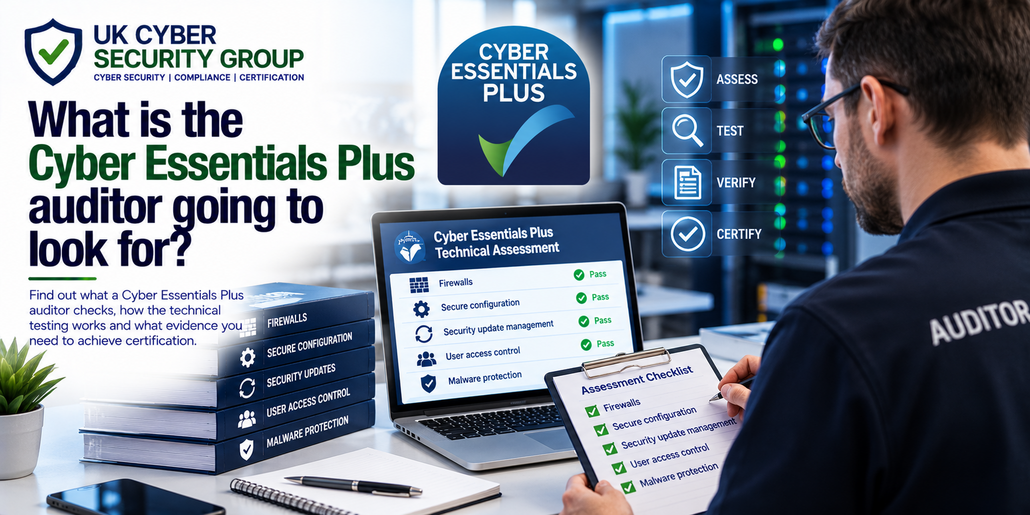
What is the Cyber Essentials Plus auditor going to look for?
Cyber Essentials Plus certification provides businesses with independent assurance that their essential cyber security controls work in practice. Unlike the standard Cyber Essentials assessment, which involves completing a verified questionnaire, Cyber Essentials Plus requires an independent assessor to test the organisation’s IT environment.
For many UK businesses, this technical assessment can feel daunting. Organisations may understand the Cyber Essentials requirements but remain uncertain about exactly what the assessor will examine, which devices will be selected or what evidence they need to provide.
The good news is that Cyber Essentials Plus follows a defined technical assessment process.
The assessor is not looking for a perfect IT environment or expecting every business to operate complex security technology. Instead, they want to confirm that the organisation has implemented the five fundamental Cyber Essentials controls correctly and consistently.
These controls cover firewalls, secure configuration, security update management, user access control and malware protection.
The current Cyber Essentials Requirements for IT Infrastructure are version 3.3, effective from 27 April 2026. The National Cyber Security Centre also publishes the Cyber Essentials Plus Test Specification v3.2, which explains the technical checks assessors use.
Understanding these checks before the assessment can make the certification process considerably easier.
UK Cyber Security Group Ltd provides Cyber Essentials and Cyber Essentials Plus certification services to UK organisations. As a Cyber Essentials Certification Body, the company helps businesses understand the requirements, prepare for assessment and demonstrate that their fundamental security controls operate effectively.
The most effective approach is straightforward: understand what the assessor will test, review the entire environment and resolve weaknesses before the formal assessment begins.
Cyber Essentials Plus is more than a questionnaire
Cyber Essentials and Cyber Essentials Plus use the same five technical controls.
The main difference is how the organisation demonstrates compliance.
Standard Cyber Essentials involves completing a verified self-assessment questionnaire.
A qualified assessor reviews the answers, and a senior representative of the organisation confirms their accuracy.
Cyber Essentials Plus adds technical verification.
The independent assessor examines the organisation’s infrastructure, conducts vulnerability assessments and observes how selected systems behave.
For example, a business may state that all relevant laptops receive security updates promptly.
The Cyber Essentials Plus assessor can test sampled devices to determine whether important vulnerability fixes have actually been applied.
Similarly, an organisation may claim that employees cannot perform administrative tasks using ordinary accounts.
The assessor can verify this by observing a user attempt an administrative action.
This practical verification provides greater confidence that the organisation has implemented the required controls rather than simply describing them.
What are the key requirements for achieving Cyber Essentials certification?
Cyber Essentials requires businesses to satisfy five fundamental technical controls.
Firewalls help protect devices and networks against unnecessary or unauthorised connections.
Secure configuration reduces security weaknesses arising from insecure settings, unnecessary functionality and inappropriate account configurations.
Security update management ensures that supported software receives relevant vulnerability fixes within the required timeframe.
User access control restricts system access according to legitimate business requirements and limits administrative privileges.
Malware protection helps prevent malicious software from compromising systems.
An organisation pursuing Cyber Essentials Plus needs to meet the same underlying requirements as Cyber Essentials.
However, Plus provides an additional level of assurance because a qualified assessor independently examines the environment.
This means businesses should prepare for technical verification rather than relying exclusively on questionnaire responses.
The assessor starts by checking your certification scope
Before technical testing begins, the assessor needs to understand exactly what the Cyber Essentials Plus assessment covers.
Scope is one of the most important parts of certification.
The assessor must verify that the Cyber Essentials Plus scope matches the scope of the associated Cyber Essentials certificate.
They also need to establish that the declared boundary accurately represents the networks, systems and services under assessment.
This may involve reviewing:
- Company locations and internet connections
- Laptops, desktops and relevant mobile devices
- Internally hosted servers
- Cloud infrastructure and business applications
- Internet-facing systems
- Relevant network equipment
- Remote working arrangements
- The separation of any excluded systems
A business cannot simply exclude inconvenient devices or applications without meeting the scheme’s scoping requirements.
Where an organisation has a partial scope, the assessor needs to verify that excluded systems have appropriate segregation from the certified environment.
Why scope problems can delay your assessment
Imagine a business has completed Cyber Essentials for its head office but has overlooked remote employees who access the same business services.
The assessor may question whether the scope correctly reflects the organisation.
Similarly, a company may have included local servers but forgotten an important cloud service.
These discrepancies can create delays before technical testing even starts.
The easiest way to avoid scope problems is to maintain an accurate inventory and review it against the original questionnaire.
Make sure relevant systems and cloud services have been identified.
Cloud services receive particular attention
Most UK businesses rely heavily on cloud services.
Microsoft 365, Google Workspace, customer management systems, accounting platforms and cloud storage may all fall within the certification scope.
Under the current Cyber Essentials requirements, organisations cannot exclude applicable cloud services from the assessment simply because an external provider hosts them.
The organisation remains responsible for the security arrangements it controls, including relevant authentication, access management and configuration.
For example, Microsoft manages the underlying infrastructure supporting Microsoft 365.
However, the customer still controls many account security decisions.
The assessor may therefore examine how users and administrators authenticate to relevant cloud services.
Cloud services are particularly important because employees often access them from different locations and devices.
Representative device testing
Cyber Essentials Plus does not necessarily require an assessor to examine every employee laptop in a large organisation.
Instead, the scheme uses representative sampling.
IASME explains that assessors commonly test a random sample of around 10 per cent of relevant systems, although the actual selection depends on the environment and applicable sampling requirements.
The assessor must ensure that the sample represents the infrastructure within scope.
A company might have Windows laptops, Apple computers, servers and mobile devices.
The sample needs to account for meaningful differences between those systems.
Standardised device management can make the process easier.
When devices use consistent configurations, security controls and update arrangements, the assessor can obtain a clearer view of the wider environment.
However, sampling should never encourage businesses to prepare only a handful of machines.
Every device within scope needs to meet the applicable requirements.
Test 1: Checking your internet-facing security
One of the first major technical activities is an external vulnerability assessment.
The assessor examines systems and services accessible from the internet.
The purpose is to determine whether a common attacker could exploit obvious security weaknesses.
This assessment can include the organisation’s public IP addresses and relevant cloud infrastructure.
The assessor uses approved vulnerability assessment tools to examine exposed services.
They may identify unnecessary open ports, insecure services or known weaknesses affecting internet-accessible systems.
What does the external assessment reveal?
An organisation might discover that a remote access service remains publicly accessible even though employees no longer need it.
Another business may have an internet-facing server that has missed important security fixes.
A company might also have forgotten an old service running in a cloud environment.
These issues can provide attackers with unnecessary opportunities.
Before the formal assessment, businesses should review their internet-facing infrastructure and confirm that exposed services have a legitimate business purpose.
Unnecessary services should not remain accessible simply because nobody has reviewed them.
Is this a penetration test?
Cyber Essentials Plus includes technical vulnerability testing, but it should not be confused with a comprehensive penetration test.
A penetration test can investigate broader attack scenarios, application weaknesses and complex exploitation paths.
Cyber Essentials Plus focuses on verifying the technical controls defined by the scheme.
Its external assessment looks for weaknesses relevant to common internet-based attacks.
An organisation may therefore achieve Cyber Essentials Plus while still benefiting from additional security assessments appropriate to its risks.
Test 2: Checking security updates and vulnerabilities
Security update management is one of the most important areas of a Cyber Essentials Plus assessment.
The assessor checks whether relevant devices contain known vulnerabilities for which necessary fixes should already have been applied.
The current technical assessment includes authenticated vulnerability scanning of sampled devices, servers and applicable cloud infrastructure.
Authenticated scanning allows the assessment tool to examine installed software and relevant system information.
The assessor then reviews detected vulnerabilities against the Cyber Essentials requirements.
The 14-day vulnerability requirement
Cyber Essentials requires relevant vulnerability fixes to receive attention within a defined period.
Under the current requirements, applicable fixes generally need to be applied within 14 days when they address vulnerabilities that:
- The vendor identifies as critical or high risk
- Have a CVSS v3 base score of 7 or above
- Have no severity information provided by the vendor for the vulnerabilities addressed
This applies to relevant supported software within scope.
A business should not assume that updating Windows automatically addresses all security update requirements.
Browsers, office applications, remote access software, server applications and other installed products may also require security fixes.
What happens if the assessor finds missing updates?
If the assessor identifies a relevant vulnerability with a vendor fix that has been available for more than 14 days, the affected test can fail.
This makes security update management an important preparation activity.
Before the audit, review whether systems are current.
Check laptops that employees rarely connect to the company network.
Investigate devices that have stopped reporting into management systems.
Review failed updates and unsupported applications.
A device that works normally may still create a certification problem when important vulnerabilities remain unresolved.
The 2026 changes make update management even more important
IASME introduced important changes to Cyber Essentials Plus update-management testing in April 2026.
These changes address situations where organisations corrected vulnerabilities only on devices selected for the original assessment.
Under the revised approach, an organisation that fails the initial update-management test must correct the issues across the environment.
During retesting, the assessor checks the original sample and also examines a new random sample.
This helps confirm that the organisation has resolved the wider update-management problem rather than simply preparing individual machines.
IASME also states that a second failure under this process results in revocation of the associated verified Cyber Essentials certificate.
For organisations preparing for certification, the message is clear.
Do not concentrate exclusively on the devices the assessor selects.
Maintain security updates consistently across every relevant system.
Unsupported software is a serious certification problem
Cyber Essentials requires organisations to use software that continues to receive appropriate vendor security support.
Unsupported operating systems and applications create unnecessary exposure because the vendor may no longer provide fixes for newly discovered vulnerabilities.
An assessor may identify unsupported software during testing.
Businesses should therefore review operating systems and applications before the assessment.
Particular attention should go to older laptops, specialist applications, unused virtual machines and systems that have remained in service for several years.
If business-critical software depends on an unsupported operating system, address the issue before certification preparation reaches the technical audit.
IASME confirms that unsupported software within scope prevents an organisation from attaining Cyber Essentials certification.
Test 3: Examining malware protection
The assessor also checks whether sampled systems have appropriate protection against malicious software.
Cyber Essentials allows organisations to meet the malware protection requirements through approved approaches, including suitable anti-malware software or appropriately controlled application execution.
For organisations using endpoint protection, the assessor checks that relevant protection is present and operational.
The assessment can include approved harmless test files.
These files allow the assessor to observe whether the organisation’s security controls detect or block content that represents a potential malware threat.
Testing malicious content delivered through email
Email remains a common route for malicious attachments and social engineering.
The assessor may send approved test files to an account operated by the organisation.
They then observe what happens when the relevant user attempts to access the content.
The objective is to verify that the organisation’s protective controls behave in accordance with the test specification.
Depending on the security arrangement, email filtering, endpoint protection or other safeguards may prevent harmful content from reaching or affecting the user.
The assessor records whether the required protection operates correctly.
Testing content downloaded through a browser
The assessor may also examine what happens when a user attempts to access approved test files through a web browser.
The test helps determine whether the organisation’s malware protection can prevent unsafe content from affecting relevant devices.
Some organisations rely heavily on web filtering.
Others use endpoint security controls.
The assessor considers how the implemented arrangement behaves under the prescribed checks.
A business should not assume that purchasing endpoint security software automatically guarantees a pass.
The product needs to operate correctly across the relevant environment.
What about managed endpoint protection?
Many organisations use central security platforms to manage malware protection.
These platforms can make certification preparation easier by showing whether devices have working protection.
Before the audit, review management reports.
Look for devices that have stopped communicating with the security platform.
Investigate inactive protection, configuration inconsistencies and unexpected exclusions.
Make sure recently issued laptops receive the same protection as established devices.
Consistent management provides stronger assurance than relying on employees to maintain individual systems.
Test 4: Verifying multi-factor authentication
Multi-factor authentication, commonly called MFA, is another important Cyber Essentials Plus assessment area.
MFA helps protect accounts by requiring an additional authentication factor beyond a password alone.
The current Cyber Essentials requirements make MFA mandatory for applicable cloud services where the service makes it available.
The assessor checks how users and administrators authenticate to the cloud services within scope.
A business may claim that MFA protects Microsoft 365, for example.
The assessor may verify this by observing an actual sign-in.
The assessor checks real authentication behaviour
The published test specification includes authentication checks using an untrusted device or a private browser session.
This reduces the chance that an existing trusted session hides a weakness in the authentication arrangements.
The assessor observes whether the relevant account receives an MFA challenge before gaining access.
Testing applies to standard user and administrator access.
Where several cloud applications use the same central authentication service, the assessor may only need to test that authentication service once.
The objective is to confirm that the security control operates rather than simply exists as an available setting.
Common MFA problems
Businesses sometimes have employees enrolled in MFA without consistently enforcing it.
An organisation may also have an old administrator account excluded from the main authentication policy.
Another company may protect Microsoft 365 but overlook a separate cloud platform that uses its own sign-in system.
These weaknesses can become visible during the technical assessment.
Review all relevant cloud authentication arrangements before the audit.
Pay particular attention to privileged accounts, exceptions and applications using independent authentication services.
A reliable first-time pass depends on MFA working when the assessor tests it.
Test 5: Confirming separation of user and administrator accounts
Cyber Essentials requires organisations to limit administrator privileges.
Employees should normally use standard accounts for routine business activity.
Administrator access should remain restricted to authorised people and appropriate administrative work.
The assessor verifies this through account separation testing.
They may ask a user on a sampled device to attempt an administrative action.
The objective is to determine whether the ordinary account already has administrator privileges.
What does a successful result look like?
A standard user attempting an administrative task should need to provide separate administrator credentials before the action can proceed.
The administrative process should not run merely because the ordinary account already holds unnecessary elevated permissions.
This principle applies to relevant sampled devices and administrative environments.
For businesses using Windows, macOS or cloud administration platforms, the assessor will consider the relevant privilege arrangements.
Why unnecessary administrator access creates risk
Administrator accounts can make significant changes to systems.
If an attacker compromises a privileged account, they may gain much greater control than they would through an ordinary user account.
Restricting these privileges reduces the potential impact of account compromise.
Before assessment, review local administrator memberships, cloud administrator roles and accounts belonging to former employees or external suppliers.
Remove permissions that no longer serve a genuine business purpose.
The aim is to make privileged access deliberate, limited and accountable.
How can I prepare my small business for Cyber Essentials assessment?
Small businesses can prepare effectively without employing a large internal security team.
Begin by identifying the IT environment.
Understand which devices employees use, which cloud services hold business information and which accounts have administrative privileges.
Review software support and security update status.
Check internet-facing systems.
Confirm that malware protection operates.
Verify that cloud MFA works in practice.
Review user permissions.
The NCSC provides free preparation resources, including the current Requirements for IT Infrastructure and the official question booklet.
IASME also provides a Cyber Essentials Readiness Tool and guidance for organisations approaching certification.
A small business should use these resources before completing its verified self-assessment.
For Cyber Essentials Plus, an additional technical readiness review can help identify weaknesses that the assessor might otherwise discover.
What documentation should you prepare?
Cyber Essentials Plus is primarily a technical assessment.
However, accurate supporting information can make the process much smoother.
The assessor may need information about:
- Current Cyber Essentials certification
- Assessment scope
- Relevant networks and internet connections
- Public IP addresses
- Device inventory
- Operating systems and applications
- Cloud services
- Administrator and standard accounts
- Endpoint security arrangements
- Security update status
- Relevant system ownership
Not every business needs to create a separate document for every item.
Existing IT records, management dashboards and system inventories may provide suitable information.
The important point is accuracy.
If the organisation’s inventory says it has twenty laptops but the endpoint management platform shows thirty, investigate the difference before assessment day.
Prepare employees for technical testing
Cyber Essentials Plus involves more than running automated assessment tools.
The assessor may need to observe users performing ordinary tasks.
These can include opening emails, browsing the internet, signing into cloud services or attempting an administrative action.
Employees should understand that the assessor is conducting authorised technical checks.
Relevant devices need to be available.
Users may need to demonstrate sign-in behaviour.
IT staff should be available to answer questions about system configurations and management arrangements.
The organisation should also provide appropriate written authorisation for testing.
Good coordination helps the assessment proceed efficiently and reduces avoidable delays.
Can Cyber Essentials Plus be completed remotely?
Yes.
IASME confirms that Cyber Essentials Plus assessments can take place remotely or in person.
The appropriate approach depends on the organisation’s IT environment and the arrangements agreed with the Certification Body.
Remote testing may involve controlled access to selected systems and observation of user activities through an agreed remote session.
Some environments may require additional coordination or on-site assessment.
Discuss the practical arrangements before booking the audit.
The assessor still needs sufficient evidence to verify the controls regardless of where the technical assessment takes place.
What software solutions support compliance with Cyber Essentials standards?
Cyber Essentials does not require every organisation to purchase the same security products.
Different solutions can help support the five controls.
Endpoint protection can help reduce malware risk.
Device management platforms can support consistent configuration and security update management.
Identity management services can help maintain appropriate authentication and administrator permissions.
Vulnerability management tools can identify weaknesses before the official assessment.
Asset management platforms can help organisations maintain accurate information about devices and applications.
Firewall management tools can support the review of internet-facing security arrangements.
Microsoft environments may use services such as Intune, Entra and Defender.
Other organisations may use security platforms such as SentinelOne or specialist vulnerability assessment services.
The important point is that the technology supports the required security outcome.
Buying a security product does not automatically demonstrate compliance.
The assessor verifies the controls operating in the real environment.
What commonly causes Cyber Essentials Plus failures?
Certification problems often arise from ordinary weaknesses in IT management.
Common examples include outdated software, missing security fixes, unsupported applications, unnecessary administrator rights and MFA that does not operate consistently.
Other problems can include inactive endpoint protection, forgotten internet-facing services and inaccurate assessment scope information.
Remote employees may also use devices that have stopped receiving central security policies.
Cloud platforms sometimes contain old accounts or authentication exceptions.
These issues are often straightforward to understand but can remain hidden when organisations lack a reliable inventory or central management process.
The most effective preparation is to identify these gaps before the assessor does.
What happens if the auditor finds a problem?
Cyber Essentials Plus has defined pass and fail requirements.
The published test specification normally requires every relevant test to pass, subject to any narrowly defined scheme exception.
A failure can prevent the organisation from receiving certification until the issue has been resolved.
IASME describes a remediation period of up to 30 days for relevant Plus assessment failures.
However, organisations should not assume that remediation provides an unrestricted opportunity to correct problems gradually.
The April 2026 update-management changes are particularly important.
If the initial update-management test fails, the retest examines both the original sample and a new random sample.
A second failure under that process results in revocation of the associated verified Cyber Essentials certificate.
The safest strategy is therefore to enter the assessment with the whole environment meeting the current requirements.
How long after Cyber Essentials must Plus take place?
Cyber Essentials Plus builds upon the verified Cyber Essentials assessment.
IASME states that the Plus technical audit must be completed within three months of the associated Cyber Essentials certification.
If the verified self-assessment was completed less than three months earlier, the organisation does not need to repeat that stage solely to proceed to Plus.
This timing matters.
Businesses should arrange the technical assessment while their Cyber Essentials certification remains within the relevant window.
Waiting too long may require another verified assessment.
Planning the two stages together can make the overall process more efficient.
Can I renew my Cyber Essentials certification through an online service?
Yes.
Cyber Essentials certification uses an online verified assessment process delivered through authorised Certification Bodies.
Organisations can complete the required questionnaire, submit their answers and obtain assessment through the official scheme.
Cyber Essentials certificates remain valid for twelve months.
Renewal should involve reviewing the current IT environment rather than copying answers from the previous year without checking them.
Over twelve months, businesses may introduce new software, recruit employees, replace devices or adopt additional cloud services.
These changes can affect scope and compliance.
For organisations maintaining Cyber Essentials Plus, regular security reviews throughout the year can make future assessments much easier.
Which companies provide Cyber Essentials certification services in the UK?
Cyber Essentials certification is delivered through Certification Bodies licensed and assured by IASME.
IASME operates the scheme as the National Cyber Security Centre’s official Cyber Essentials Delivery Partner.
The NCSC states that the scheme is supported by a network of more than 400 cyber security organisations across the UK.
Businesses can use the official IASME Certification Body directory to identify authorised providers.
UK Cyber Security Group Ltd provides Cyber Essentials certification and Cyber Essentials Plus services.
The company offers assessment and additional support for organisations that need guidance while preparing for certification.
Businesses can find further information through the UK Cyber Security Group Cyber Essentials service.
When selecting a provider, confirm that it is currently authorised to deliver the certification service required.
Which UK-based firms offer Cyber Essentials consultancy services?
Many UK information security businesses provide Cyber Essentials consultancy and assessment preparation.
These include specialist cyber security consultancies, managed service providers, NCSC-assured Cyber Advisors and Certification Bodies offering supported services.
A useful consultancy service should help organisations understand the technical requirements and identify genuine weaknesses.
For Cyber Essentials Plus, support may focus on verifying assessment scope, reviewing vulnerability exposure, checking security updates, examining MFA and assessing administrator privileges.
UK Cyber Security Group provides Cyber Essentials services alongside wider cyber security support.
For organisations without extensive internal IT security expertise, professional assistance can help reduce uncertainty and prevent avoidable assessment problems.
UK cyber security statistics show why the controls matter
Cyber Essentials Plus focuses on controls designed to reduce exposure to common cyber attacks.
The UK Government’s Cyber Security Breaches Survey 2025/2026 found that 43 per cent of UK businesses identified a cyber security breach or attack during the previous twelve months.
This represents approximately 612,000 businesses.
The figure increased to 65 per cent among medium businesses and 69 per cent among large businesses.
Phishing remained the most commonly identified attack, affecting 38 per cent of businesses.
The survey also found that only 30 per cent of businesses had undertaken a cyber security risk assessment during the previous twelve months.
These figures demonstrate the importance of maintaining fundamental information security controls.
Cyber Essentials Plus provides independent verification that an organisation has implemented the scheme’s technical baseline.
It does not eliminate every cyber security risk, but it helps businesses demonstrate that essential protections operate.
Cyber Essentials Plus certification continues to grow
Government management information published in September 2026 shows that 61,430 Cyber Essentials certificates were awarded during the twelve months from July 2025 to June 2026.
Of those, 46,245 were recorded at Cyber Essentials level and 15,185 at Cyber Essentials Plus.
This demonstrates that thousands of organisations continue to pursue the higher-assurance technical assessment.
The government also reports that organisations holding Cyber Essentials are 92 per cent less likely to make a cyber insurance claim.
That statistic concerns insurance claims rather than a guaranteed reduction in attacks.
It nevertheless provides useful industry evidence about the potential value of the scheme.
Cyber Essentials Plus strengthens that assurance by adding independent technical verification.
A practical checklist before your Cyber Essentials Plus audit
Before the assessor begins, confirm the following:
- The Cyber Essentials certificate is current and the Plus assessment is within the required three-month window.
- The declared scope accurately reflects the relevant business environment.
- Relevant cloud services have been included.
- Any excluded systems meet the applicable segregation requirements.
- Device and software inventories are accurate.
- Supported software remains in use throughout the environment.
- Relevant security fixes have been applied within the required timeframe.
- Internet-facing systems have been reviewed.
- Endpoint security operates correctly across relevant devices.
- Cloud authentication requires MFA where the scheme requires it.
- Administrator privileges remain appropriately restricted.
- Standard user accounts cannot perform privileged tasks without separate administrator credentials.
- Remote employees and their devices meet the same relevant security requirements.
- The organisation can provide representative devices for testing.
- Relevant employees and IT support staff are available during assessment.
- Existing technical records are accurate and accessible.
- The organisation has reviewed the current NCSC requirements and IASME guidance.
- Any identified weaknesses have been addressed across the whole environment.
A business that can confidently demonstrate these points is likely to approach its assessment with fewer surprises.
What does the auditor really want to see?
The Cyber Essentials Plus assessor wants to verify that the organisation’s fundamental cyber security controls work.
They need to understand the scope.
They need to identify relevant systems.
They examine what attackers could access from the internet.
They check whether devices contain important vulnerabilities that should already have been fixed.
They test malware protection.
They verify that cloud MFA operates.
They examine whether ordinary users have inappropriate administrator privileges.
They also need confidence that the sampled systems accurately represent the wider environment.
The assessor is not expecting the organisation to demonstrate every possible advanced security technology.
They are checking compliance with the defined Cyber Essentials requirements.
For businesses, this provides a clear preparation target.
Make the audit an ordinary part of good IT management
The strongest way to prepare for Cyber Essentials Plus is to maintain the required controls throughout the year.
Security updates should happen consistently.
Employees should receive appropriate access.
Administrator privileges should remain restricted.
Cloud authentication should operate securely.
Malware protection should remain active.
Internet-facing systems should receive regular review.
Asset records should reflect reality.
When these activities become normal business practice, the Plus assessment becomes much less disruptive.
The organisation no longer needs to make extensive changes shortly before the assessor arrives.
Instead, the audit confirms controls that already operate.
Prepare properly and make certification easier
Cyber Essentials Plus provides UK businesses with a recognised way to demonstrate that fundamental cyber security controls work in practice.
The technical assessment is more demanding than the verified Cyber Essentials questionnaire, but the requirements are clearly defined.
The assessor examines scope, internet exposure, security updates, malware protection, multi-factor authentication and administrator account separation.
Businesses that understand these requirements and maintain consistent security controls can approach the assessment with greater confidence.
The key is preparation.
Know what systems you have.
Understand which services fall within scope.
Keep software supported.
Maintain security updates.
Protect cloud access.
Restrict administrator privileges.
Review endpoint security.
Carry out appropriate readiness checks before formal testing.
UK Cyber Security Group Ltd provides Cyber Essentials and Cyber Essentials Plus certification services for businesses seeking independent assurance of their cyber security arrangements.
With appropriate preparation and support, organisations can reduce avoidable assessment difficulties and demonstrate that their fundamental security controls operate effectively.
The assessor is not looking for paperwork that simply says your organisation is secure.
They are looking for technical evidence that the Cyber Essentials controls genuinely work.
When your systems consistently meet those requirements, Cyber Essentials Plus becomes a practical and valuable demonstration of your commitment to cyber security.
UK Cyber Security Group Ltd is here to help
Please check out our Free Cyber Insurance
Other blog posts, Your ISO 27001 Questions Answered, Get ISO 27001 Certified ,
If you would like to know more, do get in touch as we are happy to answer any questions. Looking to improve your cybersecurity but not sure where to start? Begin by getting certified in Cyber Essentials, the UK government’s scheme that covers all the technical controls that will provide the protection that you need to help guard against criminal attacks. Or just get in touch by clicking contact us


