
Why are there 2 samples for the Cyber Essentials Plus audit?
Why are there 2 samples for the Cyber Essentials Plus audit?
Cyber Essentials Plus provides UK businesses with independent assurance that their essential cyber security controls work in practice. Unlike the standard Cyber Essentials assessment, which relies on a verified self-assessment questionnaire, Cyber Essentials Plus includes technical testing conducted by a qualified assessor.
However, organisations preparing for certification may be surprised to discover that the assessment process can involve two separate samples of devices.
Why would an assessor need to examine another group of computers after testing the first sample? Does this mean the organisation has failed? Will every business need two samples? What happens if the second sample identifies further security weaknesses?
These questions have become particularly relevant following changes to the Cyber Essentials Plus assessment process in April 2026.
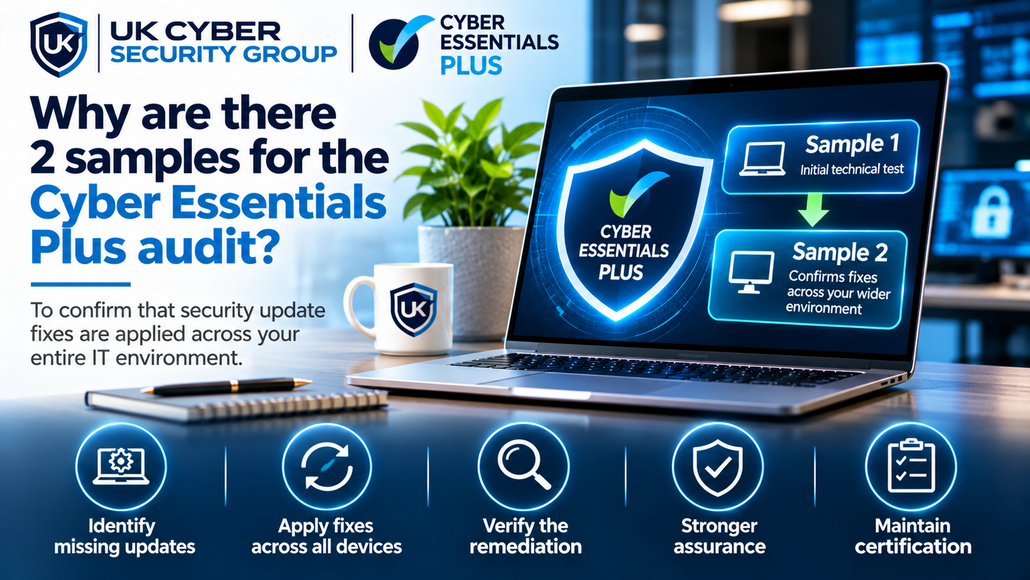
The main reason for introducing a second sample is to verify that organisations correct security update weaknesses across their entire certification scope, rather than only fixing devices selected for the original assessment.
The revised process addresses a weakness that IASME identified through previous assessments.
Some organisations corrected missing security updates on the devices selected for testing but failed to apply the same improvements across their wider IT environment.
This allowed them to pass the original retest while other devices remained vulnerable.
The updated assessment process provides greater assurance that security update management operates consistently throughout the organisation.
Importantly, not every Cyber Essentials Plus audit requires two samples. The additional sample forms part of the revised remediation process when the first sample fails the applicable security update management test.
UK Cyber Security Group Ltd provides Cyber Essentials certification and associated cyber security compliance services to UK businesses.
As an authorised Cyber Essentials Certification Body, the company helps organisations understand assessment requirements, prepare their IT environments and identify weaknesses before formal certification.
Businesses can explore UK Cyber Security Group’s Cyber Essentials certification services and obtain professional guidance on preparing for assessment.
Understanding why Cyber Essentials Plus can involve two samples helps businesses approach certification with greater confidence and avoid unnecessary failures.
Understanding the two-sample approach to Cyber Essentials Plus
The Cyber Essentials Plus assessment examines whether an organisation has implemented the five fundamental Cyber Essentials security controls effectively.
The assessor carries out technical checks against the relevant IT environment rather than relying exclusively on answers supplied through the verified questionnaire.
For many organisations, testing every computer would require considerable time and resources.
Instead, assessors select a representative sample of devices within the agreed certification scope.
The original sample allows the assessor to examine whether relevant systems meet the security requirements.
However, the April 2026 changes introduced additional verification when security update management fails.
Sample 1: The original technical assessment
The assessor selects an appropriate sample of devices from the organisation’s IT environment.
The sample should represent the relevant operating systems and device categories within scope.
During the security update management assessment, the assessor examines whether applicable software receives the necessary vulnerability fixes within the required timeframe.
If the sampled devices meet the security update requirements, the organisation does not need a second sample under this specific remediation process.
The remaining applicable Cyber Essentials Plus checks must also pass before certification can be awarded.
If the initial sample identifies missing security updates that breach the requirements, the organisation must address the findings.
Sample 2: Checking that improvements reach the wider environment
When the original security update management test fails, the organisation receives an opportunity to correct the relevant weaknesses within the permitted remediation period.
The assessor then retests the original sample to establish whether the identified issues have been resolved.
A second random sample provides additional assurance that the same weaknesses do not remain elsewhere within the certification scope.
The purpose is straightforward.
The assessor wants evidence that the organisation has corrected the wider security problem, rather than only preparing the computers selected during the first assessment.
This change strengthens the reliability of Cyber Essentials Plus certification.
Why IASME changed the assessment process in April 2026
IASME operates Cyber Essentials as the National Cyber Security Centre’s official Delivery Partner.
The organisation reviews scheme requirements and assessment processes to ensure they remain appropriate for common cyber security threats.
In February 2026, IASME announced important changes that took effect from 27 April 2026.
These changes included stronger assessment requirements concerning security updates, multi-factor authentication and verification of the organisation’s wider IT environment.
One of the most significant changes affected the Cyber Essentials Plus remediation process.
According to IASME’s official announcement, previous audits had identified cases where organisations applied security updates selectively.
What was wrong with the previous approach?
Consider a business with 100 employee laptops.
During its Cyber Essentials Plus assessment, the assessor examines a representative sample and identifies several devices missing important security updates.
The business then corrects those devices before the retest.
However, it fails to address the same vulnerabilities on other laptops.
Under the previous approach, retesting the original devices might demonstrate that those computers now meet the requirements.
The wider environment could still contain vulnerable systems.
This created a gap between the apparent assessment result and the organisation’s actual security position.
Why selective remediation creates security risks
Cyber attackers do not restrict their activity to the computers selected for a certification audit.
An attacker may target any vulnerable system accessible within the organisation’s environment.
For example, a business could successfully remediate ten assessed laptops while leaving dozens of other devices without important vulnerability fixes.
Those remaining devices could provide opportunities for compromise.
This undermines the purpose of security update management.
Cyber Essentials requires organisations to maintain appropriate security controls across the applicable certification scope.
The revised process helps verify that businesses take this responsibility seriously.
Do all Cyber Essentials Plus audits require two samples?
No.
The two-sample remediation process does not automatically apply to every Cyber Essentials Plus assessment.
The second sample becomes relevant when the initial security update management assessment identifies missing updates that cause the relevant test to fail.
If the original sample passes, the assessor does not need to select another sample simply because the organisation is pursuing Cyber Essentials Plus.
However, the assessor may carry out additional testing when necessary to obtain sufficient assurance under the normal sampling rules.
This is separate from the specific second-sample process introduced for failed security update management testing.
Does a second sample mean the organisation has failed?
The initial security update management failure means the organisation has not met that test at the first attempt.
However, the scheme provides a defined remediation process.
The organisation can correct the relevant weaknesses and demonstrate that remediation has taken place across the applicable scope.
A second sample does not automatically mean that certification is permanently unavailable.
It provides an additional opportunity to verify that the organisation has corrected the original security update failures throughout its environment.
The organisation must follow the relevant retesting requirements carefully.
How does the assessor select the first sample?
Cyber Essentials Plus uses representative device sampling because testing every device within a substantial IT environment may be impractical.
IASME’s published guidance explains that assessors commonly examine a random sample representing around 10 per cent of relevant systems.
However, this percentage does not operate as an automatic rule for every organisation.
The actual number of devices depends on the environment and the applicable sampling methodology.
Assessors must account for meaningful differences between systems.
Why operating systems matter
Consider a company using Windows laptops, Apple computers and several internally hosted servers.
Testing only Windows laptops would not necessarily provide sufficient assurance about the other systems.
The assessor needs a sample that adequately represents the relevant environment.
Different operating systems, device functions and management arrangements can influence the selection.
A business using consistent device configurations may have a more straightforward assessment than one maintaining numerous different configurations.
The assessor determines the appropriate sample according to scheme requirements.
What about remote employees?
Remote employees may use devices that form part of the organisation’s certification scope.
Those devices should meet the same applicable security requirements as equipment used in company offices.
For example, a remote employee’s laptop might rarely connect to central management services.
This could affect its security update status.
The organisation should understand whether remote devices continue receiving appropriate security management.
Remote working does not remove the responsibility to maintain compliant systems.
What happens when the first sample fails security update testing?
The initial assessment identifies whether sampled devices contain relevant vulnerabilities for which the necessary fixes should already have been applied.
If the assessor discovers missing updates that breach Cyber Essentials requirements, the security update management test fails.
The organisation must then address the identified issues.
Under IASME’s revised process, the remediation must extend across the applicable scope.
Correcting only the devices in the original sample is insufficient.
The 30-day remediation period
IASME’s detailed Cyber Essentials Plus remediation guidance establishes a 30-day period for addressing relevant failures.
The organisation must complete the necessary remediation and arrange retesting within the applicable timeframe.
For example, if an assessor discovers that several laptops lack an important browser security update, the business should investigate whether the same issue affects other relevant computers.
The organisation should then address the problem across its environment.
Once the corrective work is complete, the assessor retests the original sample.
The additional random sample helps determine whether the same issue remains elsewhere.
Why the deadline matters
Organisations should not assume they have unlimited time to resolve identified weaknesses.
The remediation process operates within a defined assessment period.
Delays can create certification difficulties, particularly when important devices remain unavailable or unresolved vulnerabilities continue to affect the environment.
Businesses should therefore review their security update arrangements before the formal assessment begins.
Preparation is considerably easier than attempting to correct widespread weaknesses under a short deadline.
What exactly does Sample 2 check?
The second sample focuses on verifying whether the organisation has addressed the original security update weaknesses throughout the certification scope.
The assessor selects another random group of relevant devices.
IASME’s detailed September 2026 guidance specifies that the second sample uses the same sampling calculation as the first.
The assessor then checks whether the vulnerabilities identified during the original assessment remain present on the newly selected devices.
Why use different devices?
Retesting the original sample demonstrates that the business corrected the problems on those particular computers.
However, it does not necessarily prove that the same changes reached other systems.
A fresh sample provides independent evidence about the wider environment.
For example, imagine the original audit identifies a missing operating system security fix.
The organisation corrects the sampled laptops.
During the second sample, the assessor examines other computers to determine whether that same missing fix remains.
If it does, the result may indicate that the organisation only performed partial remediation.
When does Sample 2 take place?
IASME’s detailed remediation guidance states that the assessor should select the second sample only after retesting Sample 1.
The assessor must notify the applicant of the selected devices no more than 72 hours or three working days before testing.
Sample 2 must take place within the original 30-day remediation window.
There is no separate remediation period specifically for Sample 2.
These requirements make preparation across the entire environment especially important.
What happens if Sample 2 finds the same vulnerabilities?
This is one of the most serious outcomes under the revised assessment process.
If the second sample contains the same missing security updates identified during the original assessment, the result demonstrates that the organisation has not completed the necessary remediation across its wider environment.
Under IASME’s published rules, this leads to failure of the Cyber Essentials Plus assessment.
The associated verified Cyber Essentials certificate will also be revoked.
This consequence reflects the importance of consistent security update management.
Why can the original Cyber Essentials certificate be revoked?
Cyber Essentials Plus builds upon the verified Cyber Essentials self-assessment.
During that earlier assessment, a senior representative confirms the accuracy of the organisation’s answers.
The business also commits to maintaining the relevant security controls.
If subsequent technical testing demonstrates that important security update requirements remain unmet after the prescribed remediation, this raises concerns about compliance with the underlying Cyber Essentials requirements.
The revised process therefore carries consequences beyond the Plus assessment itself.
Organisations should confirm the applicable rules with their Certification Body and treat update management failures as urgent compliance issues.
What if Sample 2 discovers different vulnerabilities?
A second sample may identify missing updates unrelated to the original findings.
IASME’s detailed remediation guidance distinguishes this situation from discovering the same vulnerabilities again.
Where Sample 2 identifies different missing updates, the guidance provides for an advisory requiring the organisation to address those issues.
It also recognises that further action may depend on applicable NCSC requirements.
The distinction matters because the second sample specifically checks whether the original remediation reached the wider environment.
However, businesses should never interpret this provision as permission to ignore newly identified vulnerabilities.
The organisation should address relevant weaknesses and maintain compliance with the full security update management requirements.
The Certification Body will determine the applicable assessment outcome using current IASME and NCSC guidance.
What happens in a very small organisation?
A business with only a few computers may have limited opportunities to select completely different devices.
IASME’s detailed remediation guidance recognises this situation.
Where the organisation has additional devices that were not included in the original sample, the assessor can select from the remaining equipment.
However, the initial assessment may already have examined every relevant device.
In that situation, the assessor cannot create a new sample from computers that do not exist.
Instead, the guidance provides for further verification through rescanning the complete original sample.
A practical example
Imagine a consultancy with three laptops.
The assessor includes all three devices in the initial assessment.
One laptop fails because it lacks a required security update.
The organisation addresses the issue.
During retesting, the assessor verifies remediation across the original devices because the assessment already covered the entire relevant device population.
This approach maintains the objective of verifying security updates without introducing an impossible sampling requirement.
Small businesses should discuss their specific circumstances with their Certification Body before assessment.
Why the 14-day security update requirement matters
Cyber Essentials requires organisations to maintain supported software and address relevant high-risk and critical vulnerabilities within the prescribed timeframe.
The current Requirements for IT Infrastructure, version 3.3, took effect on 27 April 2026 for new assessments under the revised question set.
The security update management requirements focus on relevant vendor fixes that address significant vulnerabilities.
These generally include vulnerabilities that vendors identify as critical or high risk, those with a CVSS v3 base score of 7 or above, and relevant vulnerabilities where vendors provide no severity information.
Applicable fixes must normally receive attention within 14 days of release.
Security updates extend beyond Windows
Businesses sometimes concentrate on operating system updates while overlooking other software.
For example, employee laptops may have current Windows updates but outdated web browsers.
Other common concerns include office applications, remote access software, specialist business applications and relevant device firmware.
Security update management must consider applicable software throughout the certification scope.
A business should not assume that one automated update service addresses every requirement.
The organisation needs sufficient visibility to identify software that requires attention.
Why unsupported software creates problems
Unsupported software presents additional security risks.
Once a vendor stops providing security support, newly identified vulnerabilities may remain unresolved.
This can prevent an organisation from meeting Cyber Essentials requirements.
Businesses should therefore maintain accurate information about the software used across their relevant environment.
Older devices, specialist systems and forgotten applications deserve particular attention.
What are the key requirements for achieving Cyber Essentials certification?
Cyber Essentials provides a recognised technical security baseline for UK organisations.
The scheme focuses on five fundamental controls designed to reduce exposure to common cyber attacks.
Firewalls
Firewalls help protect devices and networks against unnecessary or unauthorised connections.
Secure configuration
Secure configuration reduces weaknesses arising from insecure settings, unnecessary functionality and inappropriate account arrangements.
Security update management
Security update management helps ensure that relevant supported software receives necessary vulnerability fixes within the required timeframe.
User access control
User access control restricts access according to legitimate business needs and limits unnecessary administrative privileges.
Malware protection
Malware protection helps prevent malicious software from compromising systems and information.
These controls apply to both Cyber Essentials and Cyber Essentials Plus.
The main difference concerns how the organisation demonstrates compliance.
Standard Cyber Essentials uses a verified self-assessment questionnaire.
Cyber Essentials Plus adds independent technical verification.
Cyber Essentials Plus tests more than security updates
Although the revised second-sample process focuses on security update management, the wider Cyber Essentials Plus audit examines several important security areas.
The assessor needs confidence that the organisation implements the applicable five controls correctly.
External vulnerability assessment
The assessor examines relevant internet-facing systems and services.
This assessment helps identify security weaknesses that an internet-based attacker could potentially exploit.
For example, a business may have an old remote access service that no longer serves a legitimate purpose.
Another organisation might operate an internet-facing server with known security weaknesses.
The assessor evaluates relevant findings against the scheme’s requirements.
Malware protection
Cyber Essentials Plus includes checks concerning the operation of appropriate malware protection.
The assessor may use approved harmless test files to examine how relevant systems respond to potentially malicious content.
The objective is to verify that the organisation’s protective arrangements work as required.
Multi-factor authentication
Multi-factor authentication provides additional protection for user accounts.
The assessor may examine authentication arrangements for relevant cloud services.
This includes checking whether applicable users and administrators must complete the required authentication process.
Administrator account separation
Cyber Essentials requires organisations to restrict administrative privileges.
The assessor may verify that ordinary user accounts cannot perform administrative tasks without appropriate separate administrator credentials.
These checks help establish whether the organisation maintains the required access restrictions.
How can I prepare my small business for Cyber Essentials assessment?
Small businesses can prepare effectively without employing a large internal cyber security department.
The most important starting point is to understand the relevant IT environment.
Identify the devices employees use, the cloud services supporting business operations and the accounts with administrative privileges.
Review software support and security update status.
Consider internet-facing systems, malware protection and authentication arrangements.
Remote employees and relevant mobile devices should receive appropriate attention.
Prepare the whole environment
The 2026 sampling changes reinforce the need to prepare every relevant device, not just those selected for assessment.
For example, a business might have twenty laptops.
Even if the assessor initially examines only a representative selection, all twenty relevant laptops must meet the applicable security requirements.
The organisation should also review devices that rarely connect to central management systems.
These can create unexpected security update failures.
Maintain accurate asset information
An accurate asset inventory helps organisations understand which systems require attention.
Useful information includes device ownership, operating system, relevant software and security management status.
This supports consistent preparation and helps prevent forgotten equipment from causing assessment difficulties.
The inventory should reflect actual operations rather than outdated records.
Why centralised security management helps
Businesses with consistent device management arrangements may find Cyber Essentials Plus preparation more manageable.
Centralised visibility helps organisations identify relevant systems and understand whether security controls remain active.
For example, a managed security platform may reveal that several employee laptops have stopped reporting their status.
A vulnerability management service might identify outdated applications requiring attention.
The organisation can investigate these concerns before the formal assessment.
Consistency matters more than complexity
Cyber Essentials does not require every business to operate advanced enterprise security technology.
However, it does require the applicable controls to operate effectively.
A smaller organisation with straightforward systems and well-managed updates may be better prepared than a larger business with expensive technology but inconsistent security processes.
The objective is to maintain dependable security across the certification scope.
What software solutions support compliance with Cyber Essentials standards?
Several technology solutions can help organisations maintain the five Cyber Essentials controls.
Endpoint protection services can help defend against malware.
Device management platforms can support consistent configurations and security updates.
Identity management services can support authentication and appropriate account permissions.
Vulnerability assessment tools can help identify important weaknesses before an audit.
Asset management platforms can help maintain accurate device and software information.
Security monitoring services can provide visibility of suspicious activity and potential security problems.
Software does not automatically demonstrate compliance
Purchasing a security product does not guarantee that an organisation meets Cyber Essentials requirements.
For example, a vulnerability management platform may identify missing updates.
However, the organisation still needs to address the relevant weaknesses.
Similarly, endpoint protection may exist across most devices while some systems remain unprotected.
The assessor examines whether the necessary safeguards operate in practice.
Businesses should focus on achieving the required security outcomes rather than simply accumulating technology.
What evidence helps demonstrate effective update management?
Cyber Essentials Plus is primarily a technical assessment.
However, reliable supporting information can make the process easier.
For security update management, businesses may benefit from maintaining accurate device records, relevant vulnerability reports and management information showing security update status.
The organisation should also understand whether significant weaknesses remain unresolved.
Demonstrating organisation-wide remediation
When the initial sample fails, the organisation needs to demonstrate that it has addressed the relevant weaknesses across its certification scope.
For example, central management reports may help confirm that affected devices have received necessary updates.
Vulnerability assessment results can provide additional information about outstanding weaknesses.
However, the assessor must still conduct the prescribed independent testing.
Internal management records support preparation but do not replace the formal Cyber Essentials Plus audit.
What are the most common causes of Cyber Essentials Plus failures?
Certification difficulties often arise from ordinary weaknesses in IT management.
These can include unsupported operating systems, outdated applications, missing security updates, inactive malware protection and unnecessary administrator permissions.
Cloud authentication arrangements may also create problems.
For example, an organisation might protect its main Microsoft 365 accounts with multi-factor authentication but overlook another cloud application.
Another company may have an old administrator account with inappropriate permissions.
Remote devices can create further difficulties when they stop receiving central security management.
Why update failures deserve particular attention
The revised two-sample process makes security update failures especially significant.
A business that enters assessment with widespread missing updates may face a challenging remediation task.
Even if the original sampled devices receive the necessary fixes, the second sample may reveal that the same vulnerabilities remain elsewhere.
Organisations should therefore review their entire environment before the formal audit.
The aim is to avoid relying on the remediation period as the normal method of achieving compliance.
How long does Cyber Essentials Plus certification take?
Cyber Essentials Plus builds upon the verified Cyber Essentials assessment.
IASME requires organisations to complete the Plus technical assessment within three months of the associated Cyber Essentials certification.
Businesses should therefore coordinate the two stages carefully.
If the relevant Cyber Essentials certificate falls outside that period, the organisation may need to complete another verified assessment before proceeding.
Why the two-sample process affects scheduling
When the initial security update management assessment fails, the organisation must complete remediation and retesting within the relevant timeframe.
The additional random sample also needs to take place during that period.
This creates additional coordination requirements.
Relevant devices must be available, technical support personnel may need to assist the assessor, and management must ensure that necessary remediation reaches the wider environment.
Strong preparation reduces the likelihood of needing these additional activities.
Can I renew my Cyber Essentials certification through an online service?
Yes.
Cyber Essentials uses an online verified self-assessment process delivered through authorised Certification Bodies.
Organisations can complete their assessment and renewal through the official scheme.
Cyber Essentials certificates remain valid for twelve months.
Businesses should review their IT environment before renewing rather than relying on previous answers without checking them.
New employees, devices, applications and cloud services can affect certification scope.
Renewing Cyber Essentials Plus
Cyber Essentials Plus certification also requires annual renewal.
The organisation must meet the relevant Cyber Essentials requirements and complete the applicable technical assessment.
Maintaining security controls throughout the year can make renewal easier.
For example, a business that regularly reviews security updates is less likely to discover widespread vulnerabilities shortly before its next audit.
The 2026 sampling changes reinforce the importance of consistent security management between assessments.
Why Cyber Essentials Plus matters to UK businesses
Cyber threats remain a significant concern for organisations throughout the United Kingdom.
The UK Government’s Cyber Security Breaches Survey 2025/2026, published on 30 April 2026, found that 43 per cent of UK businesses identified a cyber security breach or attack during the previous twelve months.
This represents approximately 612,000 businesses.
The proportion increased to 65 per cent among medium businesses and 69 per cent among large businesses.
Phishing remained the most commonly identified attack, affecting 38 per cent of businesses.
These figures reflect incidents that organisations identified and reported, rather than every incident that may have occurred.
Why independent technical assurance matters
A verified questionnaire provides useful assurance about an organisation’s declared security arrangements.
However, technical testing can identify weaknesses that might otherwise remain unnoticed.
For example, a company may believe that all employee laptops receive security updates consistently.
An independent vulnerability assessment may reveal that several devices have missed important fixes.
Cyber Essentials Plus provides additional assurance by examining how relevant security controls operate.
The revised sampling arrangements strengthen this process by checking whether remediation extends beyond the original devices.
Cyber Essentials certification continues to grow
Government management information published in September 2026 provides further evidence of growing interest in Cyber Essentials.
During the twelve months from July 2025 to June 2026, organisations received 61,430 Cyber Essentials certificates.
Of these, 46,245 were awarded at Cyber Essentials level and 15,185 at Cyber Essentials Plus.
These figures demonstrate that thousands of UK organisations continue pursuing independent technical security assurance.
The government also reports that organisations holding Cyber Essentials are 92 per cent less likely to make a cyber insurance claim.
That statistic concerns insurance claims rather than a guaranteed reduction in cyber attacks.
Nevertheless, it provides useful industry context about the potential benefits of maintaining fundamental security controls.
The government’s Cyber Essentials management information provides the published certification figures.
Which companies provide Cyber Essentials certification services in the UK?
Cyber Essentials certification is delivered through Certification Bodies licensed and assured by IASME.
IASME operates the scheme as the National Cyber Security Centre’s official Cyber Essentials Delivery Partner.
Authorised Certification Bodies assess applications against the relevant scheme requirements.
Some also provide Cyber Essentials Plus technical assessment services.
Businesses can use the IASME network directory to identify authorised providers.
UK Cyber Security Group Ltd
UK Cyber Security Group Ltd provides Cyber Essentials certification and wider cyber security services to UK organisations.
The company helps businesses understand the requirements, complete the assessment process and prepare appropriate security information.
Its services include self-assessment certification and additional professional assistance for organisations requiring guidance.
Further information is available through UK Cyber Security Group’s Cyber Essentials certification page.
Businesses pursuing Cyber Essentials Plus should confirm the technical assessment arrangements and relevant remediation rules with their chosen Certification Body.
Which UK-based firms offer Cyber Essentials consultancy services?
UK organisations can obtain Cyber Essentials consultancy support from specialist cyber security businesses, managed service providers and qualified compliance professionals.
Useful support may include reviewing assessment scope, identifying security weaknesses, understanding technical requirements and preparing for independent testing.
For Cyber Essentials Plus, consultancy may also focus on vulnerability management, security updates, authentication and administrator account restrictions.
Why professional support can reduce assessment difficulties
Businesses sometimes struggle with certification because they do not fully understand which systems fall within scope.
Others have limited visibility of outdated software or inconsistent security arrangements.
Professional guidance can help identify these problems before the formal audit.
UK Cyber Security Group provides Cyber Essentials certification and associated support services.
Working with experienced cyber security professionals can help organisations understand the scheme requirements and maintain appropriate security controls.
However, no consultancy service should promise that an organisation can bypass the mandatory technical assessment.
Successful certification depends on meeting the applicable requirements.
A practical checklist before your Cyber Essentials Plus audit
Before arranging the technical assessment, organisations should consider whether their entire environment meets the current Cyber Essentials requirements.
Certification scope
Does the organisation maintain an accurate inventory of relevant devices and cloud services?
Does its Cyber Essentials scope match the planned Cyber Essentials Plus assessment?
Are remote employees and relevant devices accounted for?
Security update management
Does supported software receive relevant vulnerability fixes within the required timeframe?
Has the organisation reviewed operating systems, applications and relevant firmware?
Can management identify devices that have missed important updates?
Malware protection and access control
Does appropriate malware protection operate across relevant devices?
Do cloud services enforce multi-factor authentication where required?
Are administrative privileges appropriately restricted?
Assessment preparation
Are relevant devices available for testing?
Can employees and technical support personnel assist the assessor?
Has the organisation reviewed the current IASME and NCSC requirements?
Preparing for possible remediation
Does management understand the 30-day remediation arrangements?
Can the organisation coordinate the correction of security update weaknesses across its entire scope?
Does it understand that a second random sample may follow an initial update management failure?
Can it provide the required devices for retesting?
These questions help businesses identify potential weaknesses before the formal assessment begins.
The real purpose of two samples is stronger security assurance
The revised Cyber Essentials Plus sampling process addresses an important weakness in the previous approach to security update management.
Under the earlier arrangements, organisations could potentially correct only the computers selected during the initial technical assessment.
Other devices might continue operating with the same vulnerabilities.
The April 2026 changes address this concern by requiring additional verification when the initial security update management test fails.
The assessor retests the original sample and examines a new random selection of devices.
This provides greater assurance that the organisation has addressed the relevant weaknesses across its wider environment.
The second sample is not an automatic requirement for every Cyber Essentials Plus audit. It is a safeguard within the remediation process for failed security update management testing.
For businesses, the message is clear.
Do not concentrate exclusively on the devices an assessor might select.
Maintain appropriate security controls across every relevant system within the certification scope.
Keep software supported.
Review security update status regularly.
Maintain accurate asset information.
Investigate devices that stop receiving central management.
Address significant vulnerabilities throughout the environment rather than waiting for an assessment failure.
UK Cyber Security Group Ltd provides Cyber Essentials certification and cyber security support services for businesses seeking to strengthen their security arrangements and prepare for assessment.
Organisations can visit UK Cyber Security Group to learn more about its certification services and available assistance.
Cyber Essentials Plus is not designed to reward businesses for preparing a handful of computers for inspection.
It provides independent assurance that fundamental security controls work across the relevant organisation.
The two-sample process reinforces that objective by encouraging consistent security update management and demonstrating that improvements extend beyond the first devices an assessor examines.
For UK businesses, this creates a stronger foundation for protecting information, reducing avoidable vulnerabilities and maintaining customer confidence.
UK Cyber Security Group Ltd is here to help
Please check out our Free Cyber Insurance
Other blog posts, Your ISO 27001 Questions Answered, Get ISO 27001 Certified ,
If you would like to know more, do get in touch as we are happy to answer any questions. Looking to improve your cybersecurity but not sure where to start? Begin by getting certified in Cyber Essentials, the UK government’s scheme that covers all the technical controls that will provide the protection that you need to help guard against criminal attacks. Or just get in touch by clicking contact us


